
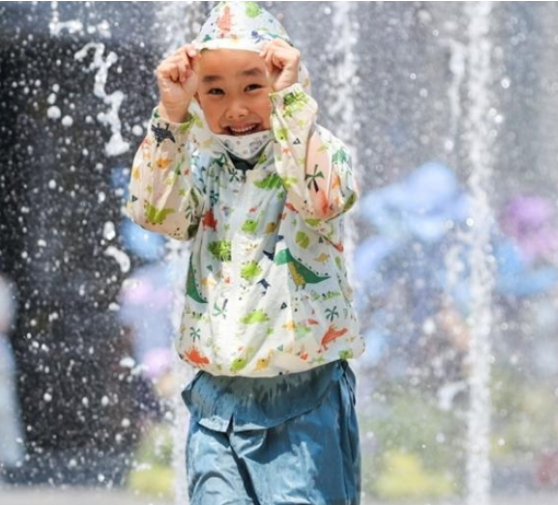

A 53-year-old Beijing resident named Su expressed his astonishment at the intense heatwave, stating that in his three decades of living in Beijing, he had never experienced a summer as hot as this one. Su’s complaint finds support in the National Climate Center (NCC), which revealed on Sunday that China has witnessed the highest number of hot days in the past 60 years, accompanied by multiple rare heatwaves sweeping across the country’s northern cities.
The NCC reported that this year, China has recorded an average of 4.1 days with temperatures exceeding 35°C, marking the highest number since records began in 1961. Among the northern regions, Beijing, followed by Hebei Province and Tianjin Municipality, has been severely affected. From June 21 to Friday, 22 weather observatory points in North China documented historically high temperatures, with approximately 450,000 square kilometers of land experiencing temperatures surpassing 37°C in recent days. Beijing, in particular, endured consecutive days of temperatures over 40°C throughout June, according to the NCC.
Su humorously compared going outdoors in Beijing to “surfing in an oven.” In response to the scorching conditions, Beijing has established “cooling booths” that provide cold water, air-conditioned areas, and even free laundry services to assist outdoor workers in coping with the heat.
The NCC described the intense heat in North China as exceptionally rare, predicting that heatwaves will persist in certain parts of North and Southwest China, with temperatures 1°C to 2°C higher than previous years. Zhao Wei, chief forecaster at the Beijing Meteorological Station, attributed the prolonged and widespread heatwave to a warmer air mass enveloping the Beijing-Tianjin-Hebei region and the absence of cloud cover, facilitating increased solar radiation and heat generation.
The sweltering weather has led to increased demand for sun protection products such as face bikinis, ice silk sunscreen sleeves, and masks. Data from Chinese e-commerce platforms indicate that consumers in Beijing, Guangdong, and Jiangsu have spent the most on sun protection items. Sales of face bikinis, masks, and similar items have surged by 50% compared to the same period last year.
Furthermore, the National Meteorological Center (NMC) issued a blue alert for the southwestern region of China due to heavy rain and the consequent risk of landslides. Tragically, six people lost their lives in Wanzhou, Chongqing Municipality, on Friday as a result of a landslide triggered by the downpour.
Unusual weather patterns have become increasingly prevalent worldwide this summer. Heatwaves, like the one that impacted parts of the South and Midwest in the US and claimed the lives of over a dozen individuals, are becoming more frequent. American experts warn that these extreme weather events, which cause more fatalities than hurricanes and tornadoes, are expected to escalate in the future.
Zhou Bing, chief of climate service at the China Meteorological Administration (CMA), attributed the recent frequency of extreme weather in China to the emergence of the El Niño phenomenon. Zhou explained that El Niño leads to increased rainfall in southern China and decreased rainfall in northern China, resulting in flooding in the south and drought in the north.
China’s power grids faced challenges last summer due to persistent heatwaves, prompting the China Electricity Council to anticipate a maximum load of 1.37 billion kilowatts on the grid this year, which is 80 million kilowatts higher than last year. However, the council predicts a balance between electricity supply and demand in China this summer. To meet the surging demand, the