
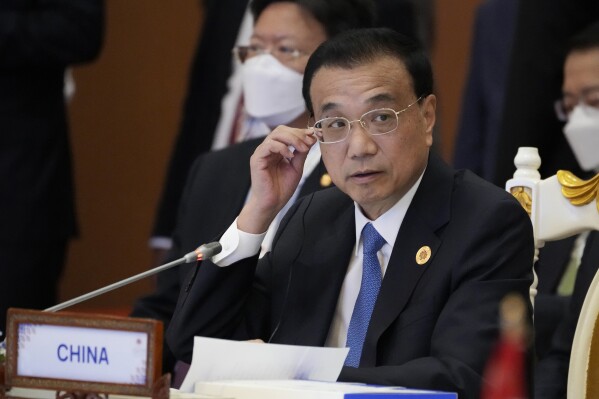

The unexpected demise of China’s former second-in-command, Li Keqiang, has sent shockwaves across the nation. Li, who had championed market-oriented reforms but found himself sidelined in the political arena, passed away from a heart attack early on Friday.
For a decade, Li had been the driving force behind China’s economic policies, guiding the world’s second-largest economy through various challenges, including mounting political, economic, and military tensions with the United States, as well as the COVID-19 pandemic.
In its brief obituary, the official Xinhua News Agency hailed Li as an exemplary member of the Communist Party of China, a devoted communist soldier with a proven track record, and an exceptional revolutionary, statesman, and leader of both the Party and the state.
Li was renowned for advocating private business initiatives, but his influence waned as President Xi Jinping consolidated his power and prioritized the military and security services in pursuit of the “great rejuvenation of the Chinese nation.”
His unexpected passing triggered an outpouring of grief on Chinese social media, with a related hashtag on Weibo amassing over 1 billion views in just a few hours. Users expressed their condolences and admiration for Li’s dedication and contributions to China.
While the Chinese government initially had little to say about Li’s passing, foreign dignitaries, including U.S. Secretary of State Antony Blinken and U.S. Ambassador to China Nicholas Burns, extended their condolences. Japan’s embassy in China also expressed its condolences, highlighting Li’s role in bilateral relations.
Li, an economist fluent in English, belonged to a generation of politicians who came of age during a period of greater openness to Western ideas. His early exposure to politics during the tumultuous Cultural Revolution eventually led him to Peking University, where he studied law and economics based on his own merits, rather than political connections.
About a decade ago, Li was once considered the favored successor to then-Communist Party leader Hu Jintao as president. However, the need to balance party factions led to the selection of Xi, the son of a former vice premier and party elder, as the consensus candidate.
Though Li and Xi did not form a partnership akin to the one between Hu and Premier Wen Jiabao, or Mao Zedong and Zhou Enlai, they did not openly disagree on fundamental issues.
Last October, Li was excluded from the Standing Committee during a party congress, despite being more than two years away from the informal retirement age of 70. He stepped down in March and was succeeded by Li Qiang, a close associate of Xi from their time in provincial government. This shift marked a departure from the skilled technocrats who had previously guided China’s economy, in favor of officials known for their unwavering loyalty to Xi.