
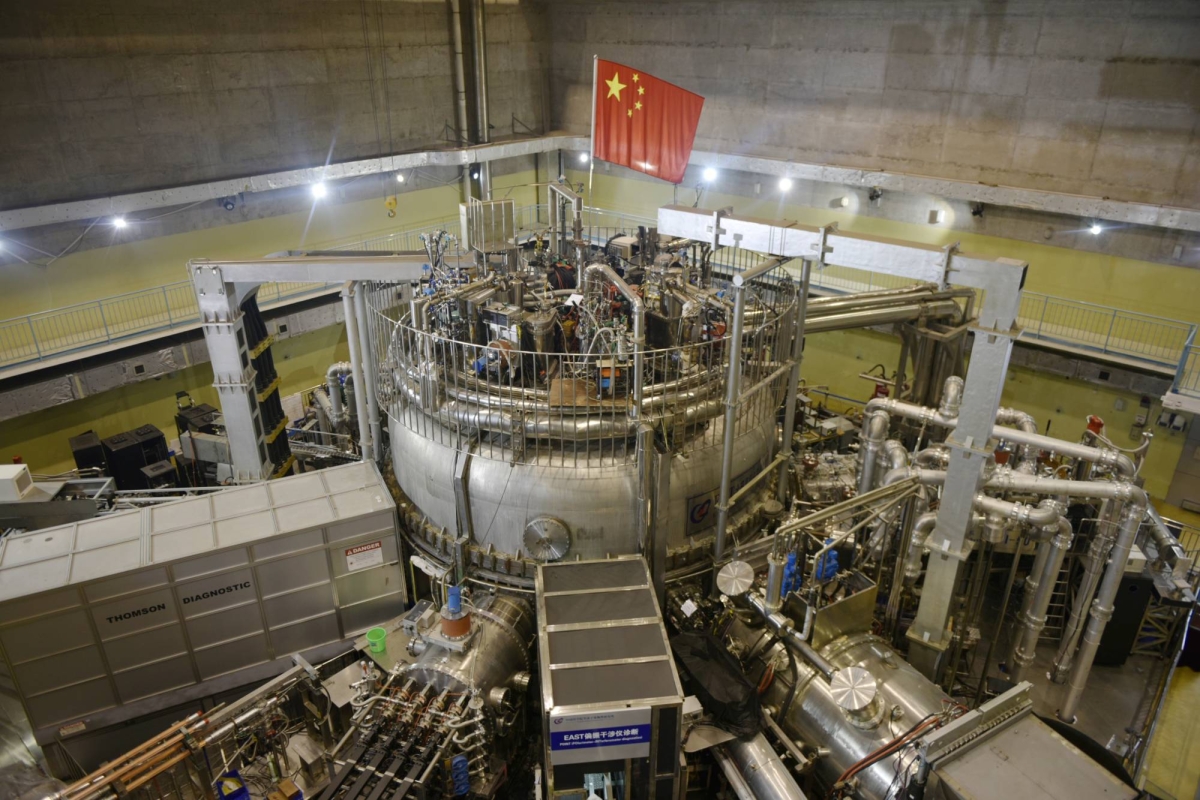

SINGAPORE, Jan 28 – China appears to be constructing a significant laser-ignited fusion research facility in the southwestern city of Mianyang, a development that could influence both nuclear weapons design and future clean energy advancements, according to experts at two analytical organizations.
Satellite imagery analyzed by Decker Eveleth, a researcher at U.S.-based CNA Corp, reveals a facility with four outlying “arms” housing laser bays and a central experiment bay designed to hold a target chamber. This chamber would contain hydrogen isotopes that powerful lasers will fuse together, potentially producing energy.
The layout of the facility is reportedly similar to the $3.5 billion U.S. National Ignition Facility (NIF) in California, which in 2022 achieved “scientific breakeven,” generating more energy from a fusion reaction than the energy input from the lasers. Notably, the Chinese facility’s experimental bay is estimated to be about 50% larger than NIF’s, suggesting its potential for higher energy output.
Dual Purpose: Weapons and Clean Energy Research
The research facility, officially named the Laser Fusion Major Device Laboratory, represents a strategic investment by China. Analysts believe such a facility could serve dual purposes: enhancing nuclear weapons capabilities and advancing clean energy research.
“Any country with an NIF-type facility can and probably will increase their confidence in existing weapons designs while facilitating future weapons development without explosive nuclear testing,” said William Alberque, a nuclear policy analyst at the Henry L. Stimson Center.
The U.S. Office of the Director of National Intelligence declined to comment, and China’s Ministry of Science and Technology did not respond to Reuters’ requests for information.
Satellite Evidence and Historical Context
The site of the facility aligns with a plot of land identified in 2020 by then-U.S. arms control envoy Marshall Billingslea, who shared satellite images showing nuclear weapons-related construction in Mianyang. Eveleth linked these observations to construction documents identifying the plot as the future home of the fusion research center.
Laser fusion research, also known as inertial confinement fusion, involves using high-powered lasers to compress and heat fuel, enabling scientists to study nuclear reactions. This research could one day enable clean power generation through hydrogen fusion, while also providing insights into nuclear detonations without actual explosive testing.
Under the Comprehensive Nuclear Test Ban Treaty, of which both China and the U.S. are signatories, nuclear explosions are banned, but “subcritical” tests and laser fusion experiments are permitted.
Implications for Nuclear Research
While laser fusion experiments help maintain the safety and reliability of nuclear arsenals, experts say their value depends on the scale of a country’s historical nuclear testing. For China, which has conducted 45 nuclear tests compared to the U.S.’s 1,054, such experiments might be less impactful due to limited baseline data.
Siegfried Hecker, former director of the Los Alamos National Laboratory, stated that China’s efforts are unlikely to significantly outpace the U.S. “I don’t think it would make an enormous difference,” he said.
Broader Scientific Context
Other nuclear powers, including France, the UK, and Russia, operate similar inertial confinement fusion facilities. According to Omar Hurricane, chief scientist for inertial confinement fusion at Lawrence Livermore National Laboratory, advancements in laser fusion technology are inevitable as scientific progress continues.
“It’s hard to stop scientific progress and hold information back,” Hurricane said. “People can use science for different means and different ends, and that’s a complicated question.”
While the facility itself is not necessarily a cause for alarm, its dual-purpose potential underscores the ongoing global race in both nuclear and clean energy technologies.