
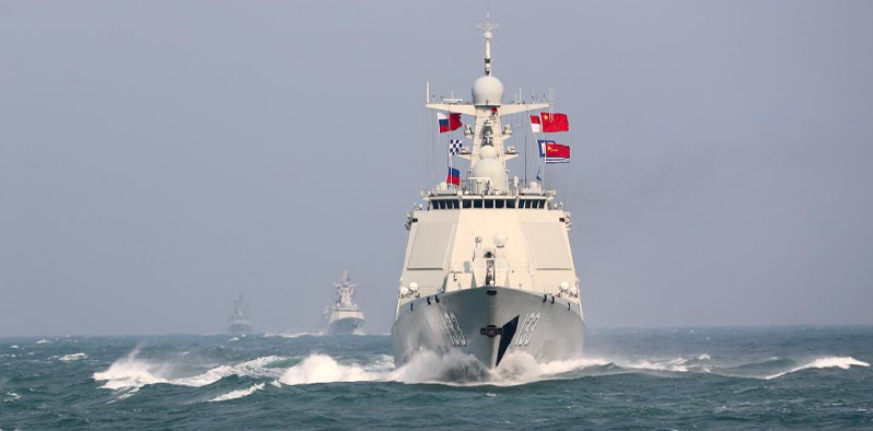

The recent joint naval patrol conducted by China and Russia in international waters near Alaska has triggered heightened concerns within US media. Despite the alarmist portrayal of the voyage as “highly provocative,” US media overlook the consistent deployment of American warships and aircraft in close proximity to China’s borders for reconnaissance and military exercises under the pretext of “freedom of navigation.”
Reports indicate that 11 Chinese and Russian vessels ventured close to the Aleutian Islands before departing without entering US territorial waters, according to US officials cited by the Wall Street Journal (WSJ) on Sunday. This maneuver was shadowed by four US destroyers and a P-8 maritime patrol aircraft.
Although a spokesperson from the US Northern Command emphasized that the patrol remained within international waters and was not deemed a threat, some US experts cited in the WSJ report characterized the joint patrol as a “historical first” and “highly provocative.”
China’s Ministry of National Defense had previously announced on July 26 that China and Russia were set to undertake their third joint naval patrol, following the Northern/Interaction-2023 joint exercises in the Sea of Japan. The initiative was clarified as unrelated to any international or regional situation, targeting no third party.
The flotilla comprised two Type 052D guided missile destroyers, two Type 054A guided missile frigates, and a Type 903 comprehensive replenishment ship from the Chinese Navy, alongside Russian Navy vessels, including large anti-submarine ships and corvettes.
China and Russia’s collaborative naval activities, including joint exercises and patrols, underscore the deep strategic trust between the two nations, further enhancing their longstanding military cooperation, according to Senior Colonel Tan Kefei, spokesperson for China’s Defense Ministry.
While the joint patrol was initiated without any aggressive intent, US media have sought to amplify the “China and Russia threat” narrative. This maneuver has been misconstrued by some quarters as related to geopolitical tensions, such as the Ukraine crisis and the Taiwan issue. Analysts attribute this portrayal to the US’s hegemonic stance and double standards, rather than reflecting actual intentions.
This is not the first time a China-Russia joint naval patrol has reached Alaska’s waters. A similar incident occurred during the second joint naval patrol between the two nations in September 2022, albeit with fewer US vessels present.
Chinese experts emphasize that the China-Russia joint patrol in the North and West Pacific serves to safeguard regional stability and security of strategic routes in the Asia-Pacific region. The US’s increased combat readiness and efforts to rally allies have raised concerns of escalating regional tensions.
Vessels of the Russian and Chinese navies take part in the joint naval and air drills North/Interaction-2023 in the Sea of Japan on July 21, 2023. The drills involve sea and air escorts, and repulsion of trespassing vessels from areas closed for navigation. Photo: VCG
The international waters in the North Pacific, including the Bering Sea, are pivotal for maritime routes, particularly as global warming potentially opens new Arctic passages for commercial activities. China and Russia’s joint patrols aim to ensure the security of these routes, while the US’s actions are viewed by some as an attempt to maintain dominance.
Despite US media portrayals, China’s naval activities have not trespassed into US territorial waters. In contrast, there have been multiple instances of US warships and aircraft operating near China’s borders, including the South China Sea and the Taiwan Strait.
Observers note the irony in US forces shadowing the China-Russia joint flotilla while themselves frequently provoking China’s sovereignty. Such actions expose a double standard, as the US expects its military presence near other countries while rejecting the same from others.
From a military perspective, the presence of four US destroyers and a patrol aircraft did not exceed monitoring capabilities. Chinese experts suggest that future far sea patrols like this could become more common for the Chinese Navy.
These joint naval patrols reflect China’s countermeasure to the US’s frequent provocations under the pretext of “freedom of navigation.” By demonstrating their capabilities, China and Russia aim to uphold regional stability and deter hegemonic actions.