
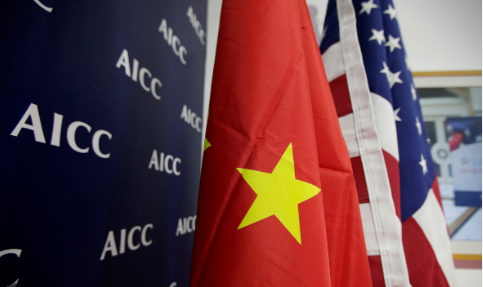

China has vehemently criticized the recent move by the US government to impose a ban on new US investments in critical technology industries within China, marking the latest salvo in Washington’s ongoing aggressive stance against China. China has lodged formal protests with the US and has pledged to undertake necessary measures to safeguard its own interests.
While US officials have cited so-called national security concerns as the rationale for the executive order and have asserted that the US is not aiming to “decouple” from China, Chinese officials and experts contend that this latest move is part of a wider US campaign to curtail China’s technological ascent. They argue that this amounts to “economic coercion” and represents a violation of fundamental market principles.
The full extent of the repercussions stemming from the US ban remains to be seen. However, insiders and analysts in China’s tech industry have brushed aside assertions of a potential chilling effect, asserting that the move has long been telegraphed by US officials. Moreover, US investments in China’s technology sector have already waned in the face of years of US-led crackdowns on the tech industry. Importantly, experts stress that this move, or any other arbitrary restrictions by the US, will not undermine China’s pursuit of technological self-sufficiency and robustness.
‘Economic Coercion’
After weeks of speculation, US President Joe Biden signed an executive order on Wednesday to prohibit fresh US investments in pivotal technology sectors in China, which could contribute to enhancing China’s military capabilities. The order specifically targets US venture capital and private equity firms, forbidding them from investing in Chinese initiatives related to semiconductors, microelectronics, quantum computers, and specific artificial intelligence applications.
The US Treasury Department has maintained that this action is a “narrowly targeted measure” aimed at “defending America’s national security,” reiterating the US commitment to open investment.
China promptly issued stern rebukes in response to the US action. A spokesperson for the Chinese Foreign Ministry declared that the US restriction on US firms’ investments in China, ostensibly for reasons of national security, is an evident attempt to overreach the concept of security and politicize business engagement. Chinese authorities view this as an effort to deprive China of its developmental rights and serve US dominance, dubbing it a case of blatant economic coercion and tech intimidation.
In a separate statement, China’s Ministry of Commerce vehemently criticized the US for ostensibly seeking to decouple bilateral investments under the guise of risk reduction. This purportedly goes against the principles of market economics and fair competition that the US traditionally espouses. The ministry asserted that China is deeply concerned about this move and reserves the right to take countermeasures.
Analysts argue that this latest move once again exposes the US’s hypocrisy and lack of credibility, as it employs “economic coercion” tactics while accusing others of the same. They maintain that the US is striving to decouple from and contain China, despite public proclamations to the contrary by top US officials. The analysts further underscore that this move reflects the US’s growing desperation, particularly since years of unrelenting crackdown measures have failed to effectively check China.
“The US continues its trajectory of constraining China’s development and does not hesitate to employ administrative orders to impede economic and trade interactions. This is a practice the US has engaged in for many years; hence, this new move carries no additional significance or chilling effect,” commented Gao Lingyun, an expert at the Chinese Academy of Social Sciences in Beijing.
Far-reaching Consequences
Amid heightened tensions in bilateral relations, the severity of the move has been amplified in foreign media. However, insiders within China’s technology industry have largely downplayed the potential for dire and direct consequences.
An executive at a Chinese tech firm argued that the market’s reaction to the US restriction order is likely to be muted. The move has been anticipated for some time, and news about it has already been absorbed. Furthermore, the business community harbors no illusions about the US government’s actions. Direct US investment in China’s high-tech sectors has been on the decline as a result of the ongoing US technology war against China.
The executive, speaking anonymously, emphasized that while Chinese companies may face challenges in terms of technological innovation, which often necessitates international cooperation, US companies will also feel the impact. These restrictions will adversely affect their competitiveness.
Although the executive order is designed to bar new investments, the Chinese tech sector has already experienced a drop in US investment due to previous restrictive measures imposed by the US. According to Reuters, total US-based venture-capital investment in China sharply declined from $32.9 billion in 2021 to $9.7 billion in 2022. This year, total venture-capital investment has reached a mere $1.2 billion.
Essentially, the ban primarily affects US companies, which is seen as inequitable for those holding intellectual property rights and technological advancements within the affected sectors. Zhou Mi, a senior research fellow at the Chinese Academy of International Trade and Economic Cooperation, remarked that this ban strips US companies of their constitutional right to reasonably allocate their funds and assets. He highlighted that, from this perspective, such action is highly irregular. Zhou further noted that the Biden administration’s move not only contravenes international market principles but also constitutes an abuse of executive power.
The move, set to come into effect next year, has introduced heightened uncertainty for Chinese and US businesses. The lack of clarity surrounding specific regulations and requirements adds to the confusion. Reports from Reuters suggest that the US government may exempt certain deals. Currently, over 70,000 US companies conduct business in China.
Gao emphasized that while administrative orders may temporarily hinder the flow of funds into China and certain Chinese companies, such bans cannot ultimately thwart the innate drive of funds to seek profitable avenues. He pointed out that US companies will always find ways to circumvent restrictions in order to invest in lucrative projects.
The wider implications of the move further complicate the already intricate relationship between China and the US. Notably, US officials continue to undertake antagonistic actions against China while simultaneously seeking dialogue with Chinese counterparts. Amid visits to China by US Secretary of State Antony Blinken and US Treasury Secretary Janet Yellen, speculation has arisen about a forthcoming visit by US Commerce Secretary Gina Raimondo.
While Raimondo’s visit has not been officially confirmed, the investment ban could potentially hinder official exchanges between the two countries. Analysts argue that mutual trust should be the cornerstone of any talks. It is difficult to envision that one party can expect the other to make corresponding adjustments while simultaneously imposing suppression and restrictions.