
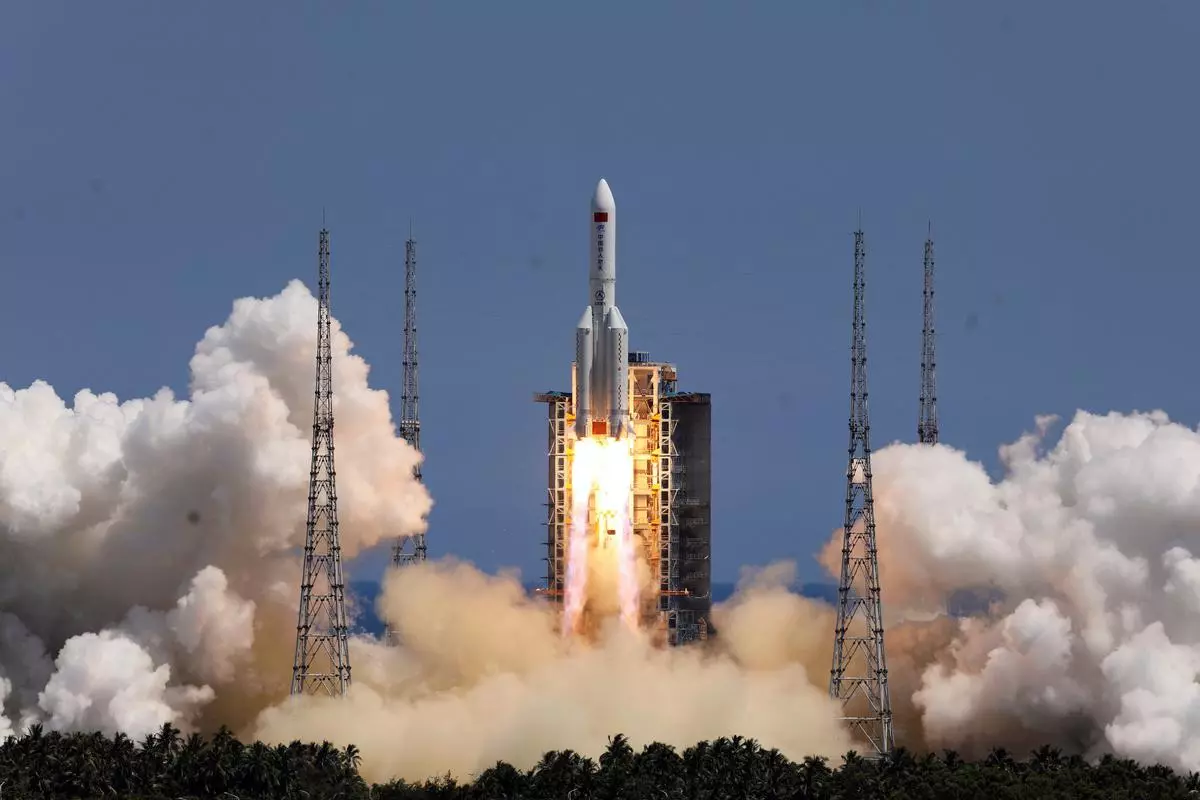

China has taken another giant leap forward in its quest to become a space superpower by successfully launching the first module of its new space station on April 6th. The new space station, named Tiangong, will replace China’s previous space lab, Tiangong-2, which was decommissioned in 2019.
The module, named Tianhe, was launched from the Wenchang Space Launch Center in southern China’s Hainan province aboard a Long March 5B rocket. Tianhe will serve as the living quarters for astronauts, and will be joined by two more modules in the coming months. The next module, Wentian, will serve as a science laboratory, while the third module, Mengtian, will be used for additional living quarters.
The launch of Tianhe is a significant milestone for China’s space program, which has been rapidly expanding in recent years. China has already sent several manned missions to space, and has successfully landed a rover on the far side of the moon. The country also plans to send a spacecraft to Mars in the near future.
China’s ultimate goal is to establish a permanent human presence in space and to eventually build a lunar base. The construction of Tiangong is a crucial step towards achieving that goal. China plans to complete construction of its space station by 2022, and the station is expected to remain in operation for at least 10 years.
The launch of Tianhe has been met with excitement and admiration from space enthusiasts around the world. However, the launch has also raised concerns among some experts, who worry about the potential militarization of China’s space program. China has been investing heavily in its space capabilities in recent years, and there are concerns that its space program could be used for military purposes.
Despite these concerns, China’s space program is likely to continue to grow in the coming years, and could eventually rival that of the United States and Russia. The launch of Tianhe is a significant step forward for China’s space ambitions, and is likely to cement the country’s position as a major player in the global space race.