
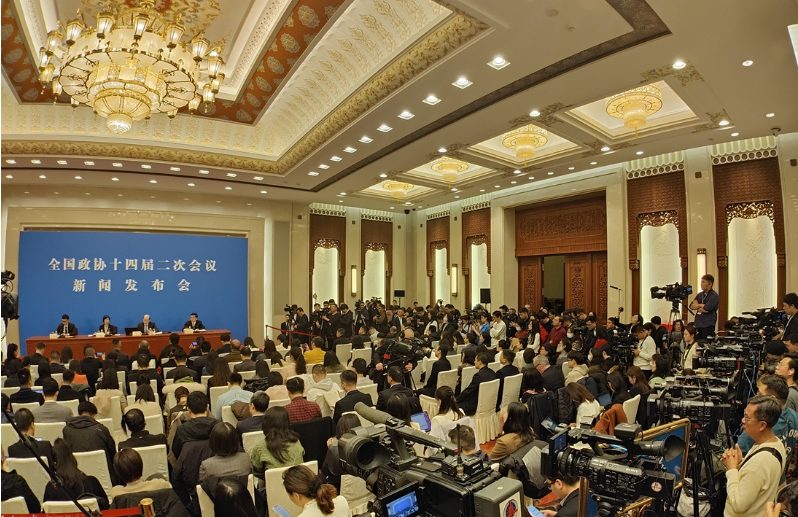

As thousands of Chinese lawmakers and policy advisors assemble in Beijing for the annual two sessions, experts highlight the significance of this event, emphasizing its role in offering insights into China’s comprehensive people’s democracy and providing a window into the country’s development and policy direction for the upcoming year.
Scheduled to open on March 5 and 4, respectively, the second session of the 14th National People’s Congress (NPC) and the second session of the 14th National Committee of the Chinese People’s Political Consultative Conference (CPPCC) draw attention to China’s well-orchestrated democratic system. Combining elections, consultations, decision-making, and oversight, it is considered a high-quality system that effectively gathers public opinion, providing timely solutions for societal advancement and national strength.
At a press conference held on Sunday, Liu Jieyi, spokesperson for the second session of the 14th CPPCC National Committee, underscored the CPPCC’s role in promoting socialist democracy, practicing whole-process people’s democracy, and acting as a vital channel for socialist consultative democracy. The year 2024 marks the 70th anniversary of the NPC’s founding and the 75th anniversary of the CPPCC’s establishment.
Experts view whole-process people’s democracy not only as a periodic voting mechanism but also as a blend of electoral and consultative democracy, covering economic, political, cultural, social, and ecological sectors. This approach aims to address the diverse needs of the population and synchronize public expectations with national development goals.
Zhang Yiwu, a professor at Peking University and a national political advisor, highlighted the return to the traditional format of the two sessions, emphasizing the concentration of opinions from various sectors and social groups. This reflects a collective commitment to fostering China’s economic development and societal progress, particularly in the post-pandemic recovery phase.
Delegates, including Xu Ruixia, a national political advisor from Inner Mongolia, shared their investigations and recommendations related to pressing issues, such as childcare facilities. Liu Jieyi acknowledged the invaluable role of political advisors, mentioning their direct engagement with communities and homes to gather real-world perspectives.
The annual two sessions not only provide a platform for deputies to address current challenges but also offer foreign observers a glimpse into China’s future development plans and the practical application of democracy in the country. Experts emphasize that real democracy must result in good governance and national development, underlining the importance of each country finding its unique path to achieve democratic ideals, free from the notion that Western-style democracy is the sole model to follow.