
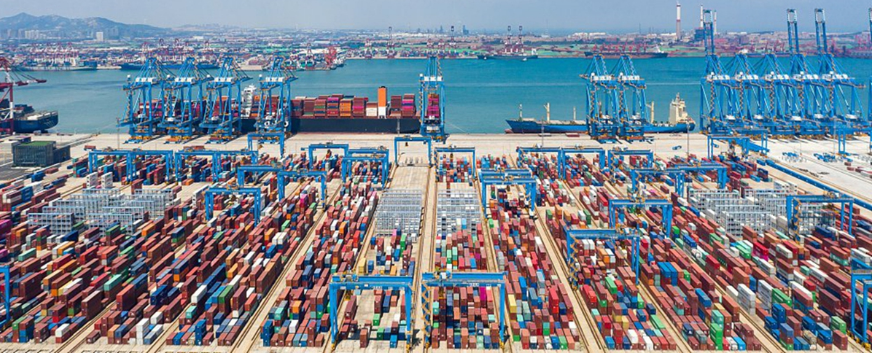

China’s foreign trade in goods has reached a historical high in the first half of 2023, reaching 20.1 trillion yuan ($2.8 trillion), indicating resilience despite a complex international landscape. The growth in trade quality has been attributed to ongoing economic recovery and industrial chain upgrading.
According to the General Administration of Customs (GAC), China’s foreign trade has shown steady growth in the first half of the year, with continued growth in trade with emerging markets. In the first and second quarters, imports and exports reached 9.76 trillion yuan and 10.34 trillion yuan, respectively, both recording positive year-on-year growth. Second-quarter trade was 6 percent higher than in the first quarter.
The GAC data also reveals a growth in imports and exports by private enterprises, with an increased proportion of electro-mechanical products in exports. Private enterprises accounted for 52.7 percent of China’s total imports and exports, amounting to 10.59 trillion yuan. Foreign-invested enterprises accounted for 30.7 percent with 6.16 trillion yuan.
The GAC reported that total exports increased by 3.7 percent year-on-year, reaching 11.46 trillion yuan in the first half of the year. Notably, exports of electro-mechanical products increased by 6.3 percent, accounting for 58.2 percent of exports. The growth in exports was driven by a significant increase in exports of electric vehicles, lithium batteries, and solar cells.
Although China’s imports slightly declined by 0.1 percent to 8.64 trillion yuan, imports of bulk commodities saw a rapid increase of 17.1 percent. Notably, imports of energy products such as crude oil, natural gas, and coal increased by 33.2 percent. Imports of consumer goods, meat, and edible aquatic products also experienced growth.
China’s trade with partners in emerging markets, including those involved in the Belt and Road Initiative (BRI), witnessed substantial growth. Trade with BRI countries grew by 9.8 percent, accounting for 34.3 percent of total foreign trade. Trade with the Association of Southeast Asian Nations (ASEAN), China’s largest trading partner, reached 3.08 trillion yuan, representing a 5.4 percent increase.
In contrast, trade with the European Union (EU) increased by 1.9 percent, reaching 2.75 trillion yuan, while trade with the United States declined by 8.4 percent. These figures highlight China’s ongoing efforts to diversify its trade partnerships and reduce dependence on specific countries.
Despite external pressures, China’s foreign trade has demonstrated resilience and an improvement in quality. The outlook for the second half of the year remains cautiously optimistic, given the high inflation in major developed economies and ongoing geopolitical conflicts. China’s economic fundamentals, along with policy measures, provide a solid foundation to promote stability and improve the quality of imports and exports.
Industry insiders and analysts express confidence in China’s foreign trade growth, particularly in new markets such as Latin America, ASEAN, and countries involved in the BRI and Regional Comprehensive Economic Partnership (RCEP). Cross-border e-commerce is expected to be a significant driver of trade growth in the coming years, with significant growth already observed in the first half of 2023.
The GAC data shows that foreign trade volume through e-commerce increased by 16 percent, with exports through e-commerce growing by 19.9 percent. Cross-border e-commerce export market is projected to reach 13.9 trillion yuan in 2025.
Overall, China aims to consolidate its market share and maintain its position as the largest country in global trade in goods. The combination of resilient economic fundamentals, policy support, and expansion into new markets contributes to the positive outlook for China’s foreign trade in the second half of 2023.