
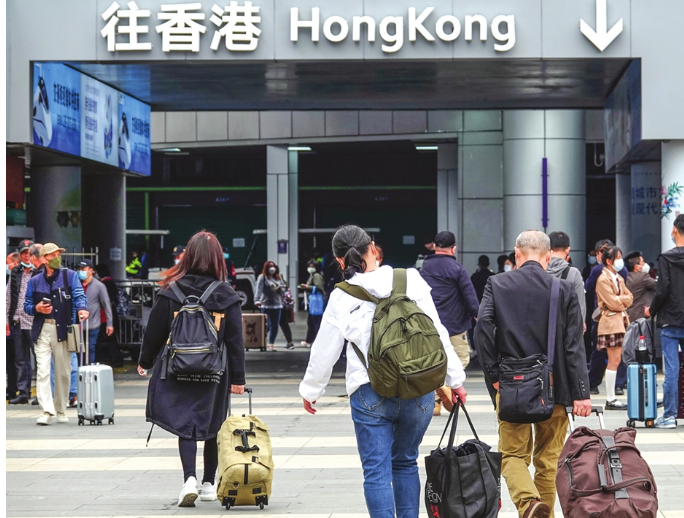

China’s National Immigration Administration (NIA) announced a series of new measures on Sunday aimed at simplifying entry and exit procedures for the public and businesses. These measures include streamlining document processing and applications, extending the duration of business stays, and catering to diverse tourism needs. Observers view this move as part of China’s efforts to enhance its high-level opening-up strategy and promote international exchange.
The implementation of these new policies, in addition to existing initiatives promoting integration within the Guangdong-Hong Kong-Macao Greater Bay Area (GBA), is expected to facilitate business, people-to-people interactions, and technology exchanges between the Chinese mainland and the Hong Kong and Macao Special Administrative Regions (SARs). Analysts anticipate that as these connections strengthen, the scope of interaction between the mainland and the two regions will expand significantly.
Furthermore, these measures are anticipated to create more business opportunities, leveraging Hong Kong’s role as a key link between the mainland and the global market and Macao’s position as a free trade port. The increased interaction is poised to inject new vitality into the development of both regions, bolstering their economies and contributing to long-term prosperity and stability.
The new policies, effective May 6, include provisions for residents in pilot cities to renew passports and travel documents online for destinations such as Hong Kong, Macao, and Taiwan. Additionally, mainland residents applying for multi-entry visas to Hong Kong and Macao for business purposes will benefit from expedited processing. The duration of stay for business travelers will be extended from seven to 14 days.
Specific policies have been tailored for high-level talent and other key groups, including measures to support outbound tourism to the SARs. Notably, Beijing and Shanghai will now issue multi-entry visas for designated categories of talent to travel to Hong Kong and Macao, further enhancing cooperation and exchange.
The Hong Kong Special Administrative Region (HKSAR) government welcomed the new measures, emphasizing their role in facilitating talent flow and promoting exchanges between the mainland and Hong Kong. These enhancements are expected to reinforce Hong Kong’s international status as a hub for talent and capital.
Commenting on the significance of these policies, experts highlighted their strategic importance amid the complex international landscape and the evolving economic and social ties between the mainland, Hong Kong, and Macao. They emphasized the role of these measures in supporting Hong Kong’s transition to prosperity and Macao’s integration into the national development agenda.
The implementation of these policies aligns with broader efforts to deepen cooperation within the Greater Bay Area and promote cross-border exchanges. By simplifying travel procedures and encouraging people-to-people interactions, these measures are expected to stimulate tourism, business, and cultural exchanges between the mainland, Hong Kong, and Macao.