
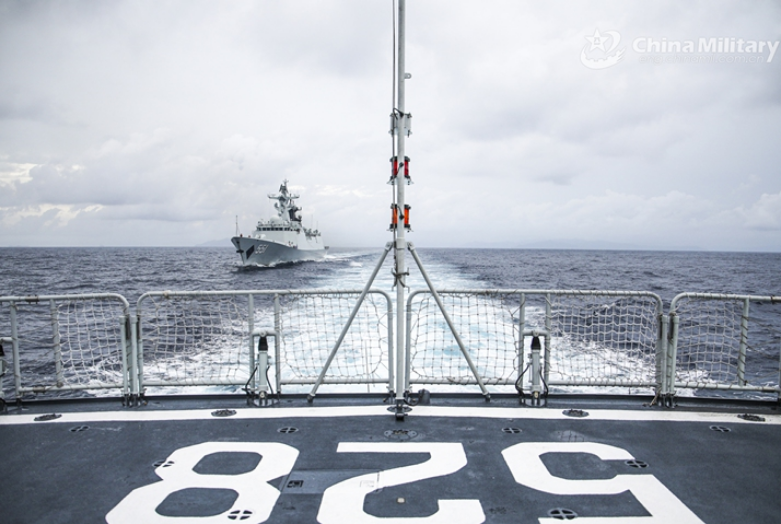

China’s People’s Liberation Army (PLA) prolonged its routine two-day patrol in the South China Sea, transitioning into a third day of joint exercises on Friday. Analysts assert that this move underscores China’s commitment and capability in safeguarding national sovereign security and maritime rights, especially in light of reports indicating a reduction in joint patrols by the US and the Philippines in the region.
The PLA Southern Theater Command organized a regular maritime and aerial joint exercise on Friday, following a two-day naval and air patrol in the South China Sea from Wednesday to Thursday. During the patrol, the Southern Theater Command pledged to maintain high alertness to protect national sovereign security and maritime rights, bringing any disruptive military activity under control.
Concurrently, the Philippines and the US conducted a two-day joint patrol in the South China Sea from Wednesday to Thursday. This marked the second such operation since November, involving four Philippine naval vessels and four US warships, including an aircraft carrier. However, reports suggest a significant scaling down of the operation.
Chen Xiangmiao, director of the World Navy Research Center at the National Institute for South China Sea Studies, clarified that the PLA Southern Theater Command’s joint exercise is a routine activity, unrelated to specific events or third-party countries. The exercise serves to evaluate weapon and system performance, enhance operational capabilities, improve military service interoperability, and gain a better understanding of the combat environment.
While the PLA regularly conducts such operations, not all are publicized. However, experts suggest that the disclosure of this exercise aims to demonstrate China’s determination and capability in protecting its rights and interests in the South China Sea.
Chinese military expert Song Zhongping emphasized China’s unwavering commitment to safeguarding national sovereign security and development interests. He stressed the need to manage and control sovereign territories through law enforcement and military operations.
Experts pointed out that the US has been encouraging the Philippines to challenge China over islands and reefs in the South China Sea. The PLA’s announcement of exercises to enhance combat preparedness should be viewed against this backdrop.
The joint patrol by the Philippines and the US was initially planned as a large-scale operation but witnessed a significant reduction, attributed to China’s perceived determination and capability. Analysts argue that a military conflict with China is not in the best interest of the US, and dialogue is the preferred path to resolving disputes for the Philippines.
The US’ decision to scale down its operations may stem from recognizing the potential consequences of a military conflict with China. Experts contend that the assumption that the US would engage in a South China Sea war for the Philippines is unrealistic, given the likelihood of it escalating into a global conflict.
China maintains a commitment to regional peace and stability, demonstrating restraint in managing maritime disputes. Restriction measures taken by the China Coast Guard against Philippine vessels trespassing on Chinese reefs, along with PLA patrols and drills, are viewed as restrained moves to safeguard national sovereign security and maritime rights.
China emphasizes its dedication to resolving differences through dialogue and consultation while urging the Philippines to return to the negotiation table. Despite being a peace-loving nation, China remains resolute in safeguarding its national sovereignty, territorial integrity, and development interests against provocations and harassment.