
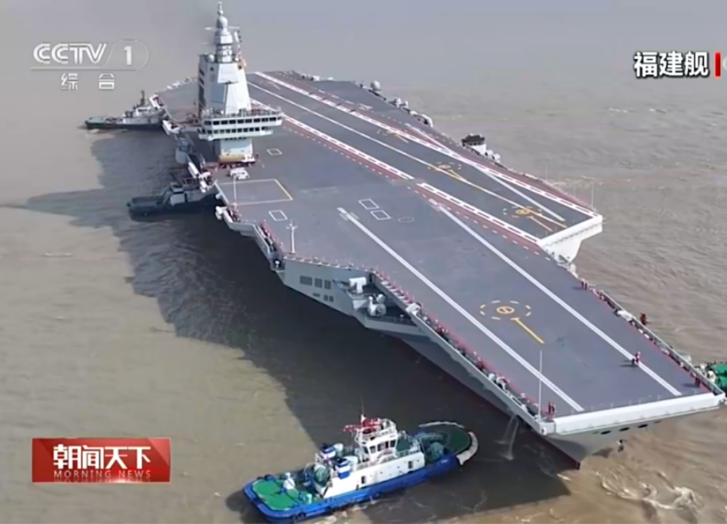

The Fujian, China’s third aircraft carrier and the first to be equipped with electromagnetic catapults, commenced its inaugural sea trial session on Wednesday, marking a pivotal milestone in testing cutting-edge technology and laying a robust groundwork for the commissioning of this 80,000-ton-class warship.
Regarded by experts as comparable to the most advanced aircraft carriers globally, the Fujian epitomizes the pinnacle of conventionally powered aircraft carrier design.
Departing from the Jiangnan Shipyard in Shanghai, the aircraft carrier Fujian embarked on its maiden test voyage on Wednesday morning, as reported by Xinhua News Agency. The momentous occasion was broadcasted live on social media platforms by China Central Television.
The official announcement of the Fujian’s sea trials followed notices issued by China’s maritime safety administration, indicating a scheduled navigation restriction in the East China Sea area until May 9, underscoring the anticipated duration of the maiden voyage.
According to Xinhua, the sea trial will primarily assess the reliability and stability of the Fujian’s subsystems, including propulsion and power.
A Chinese military expert, speaking on condition of anonymity, highlighted that initial sea trials typically focus on validating the ship’s fundamental functionalities. Subsequent trial phases will scrutinize more intricate operational components, encompassing electromagnetic compatibility, weapons systems, and aircraft takeoff and landing procedures.
Launched on June 17, 2022, the Fujian, bearing the namesake of East China’s Fujian Province and the hull number 18, has undergone meticulous construction at Jiangnan Shipyard, adhering to a meticulously devised plan. The vessel’s prolonged mooring tests facilitated seamless preparations for its maiden voyage, setting the stage for a potentially successful trial phase.
The Fujian’s construction timeline, spanning nearly two years from launch to sea trials, surpasses that of its predecessor, the Shandong, owing to the integration of advanced technologies such as electromagnetic catapults, which necessitated extensive exploration and testing.
Boasting a displacement exceeding 80,000 tons and outfitted with electromagnetic catapults and arresting devices, the Fujian represents China’s inaugural independently designed and constructed aircraft carrier featuring catapults. In contrast, China’s prior carriers, the Liaoning and the Shandong, each displacing around 60,000 tons, employ ski jump ramps for aircraft takeoffs.
Experts highlight the Fujian’s enhanced capabilities, including increased aircraft capacity and the ability to launch heavier, fully loaded aircraft more efficiently. The carrier is anticipated to accommodate an array of advanced aircraft, including improved versions of the J-15 fighter jet and new additions such as the J-35 stealth fighter, the KJ-600 fixed-wing early warning aircraft, and the JL-10 advanced trainer jet.
Embarking on its sea trial phase signifies a significant step toward the Fujian’s eventual induction into the Chinese People’s Liberation Army (PLA) Navy, underlining its pivotal role in bolstering China’s maritime capabilities and safeguarding national interests amidst evolving security dynamics. While the precise duration of the sea trial phase remains uncertain, PLA Navy and shipbuilding authorities prioritize meticulous testing to ensure the carrier attains optimal combat readiness.