
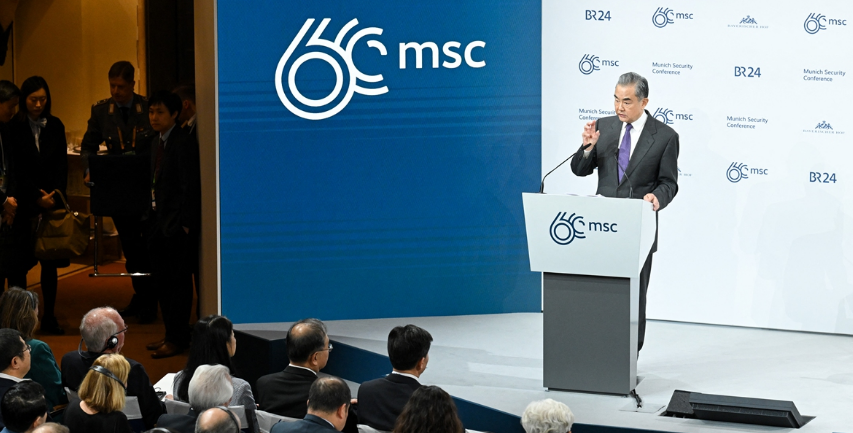

Following his participation in the Munich Security Conference (MSC) and meetings with high-level European officials, Chinese Foreign Minister Wang Yi undertook visits to Spain and France, signaling China’s proactive approach in stabilizing and enhancing communication with European nations at the start of the year, according to Chinese experts.
In his meeting with Spanish Foreign Minister Jose Manuel Albares Bueno, Wang Yi highlighted China’s willingness to work with Spain on a global and long-term perspective, emphasizing mutual trust, win-win cooperation, and strategic stability. Both sides agreed to enhance cooperation in various sectors, including telecommunications, healthcare, electric vehicles, and green energy.
During the MSC, Wang engaged in candid and in-depth conversations with European officials, addressing concerns and expressing a commitment to working with Germany and the European Union (EU). Wang emphasized China’s readiness to promote an equal and orderly multipolar world with the EU.
Wang’s visit to Europe during the Chinese New Year reflects China’s initiative to stabilize China-Europe ties and strengthen communication. Wang Yiwei, director of the Institute of International Affairs at Renmin University of China, stated that the visits to Germany and France aim to solidify bilateral ties and set the stage for higher-level visits. Additionally, Wang’s visit to Spain after nearly six years underscores Beijing’s efforts to improve ties with individual European countries and stabilize China-EU relations overall.
Amid Europe’s concerns over internal and surrounding issues such as the Russia-Ukraine conflict and potential return of Donald Trump, Wang’s visit is seen as an opportunity for China to engage with Europe and discuss its stance on the Ukraine crisis. European countries are said to be looking at China as a stabilizing force in a turbulent world.
However, Europe’s anxiety is also reflected in competition with China, with the EU planning to sanction companies in the Chinese mainland for assisting Russia in circumventing sanctions. Despite these challenges, experts anticipate increased exchanges between China and Europe in 2024, fostering mutual understanding and collaboration amid potential turbulence in the new year.