
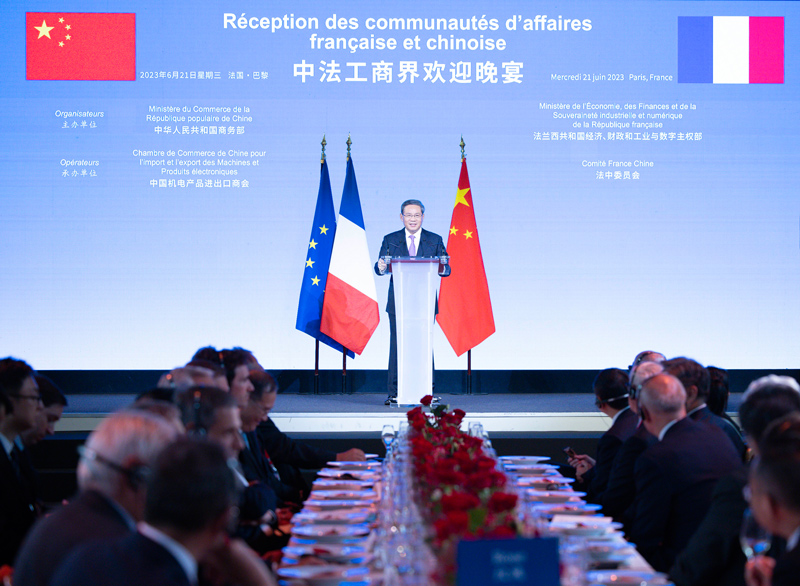

Chinese Premier Li Qiang embarked on his first overseas visit since assuming office, arriving in France to strengthen bilateral ties and expand practical cooperation between the two nations.
During his meeting with French Prime Minister Elisabeth Borne, Premier Li emphasized China’s readiness to collaborate with France in achieving balanced trade development, enhancing market access, and improving the business environment. The visit aims to elevate “bilateral practical cooperation” to new heights, showcasing the commitment of both countries to a mutually beneficial relationship.
Premier Li also urged France to play a positive role in promoting a more objective and rational perception of China within Europe. By doing so, France can contribute to fostering a climate of win-win cooperation between the two economies, ensuring it remains a central theme in their relationship. Analysts have lauded the visit as an opportunity to consolidate the positive momentum in China-France relations, counter misperceptions of China in Europe, and prevent potential conflicts from escalating into confrontation.
The trip holds significance as it seeks to facilitate deeper engagement and cooperation between China and France, as well as China and Europe, across various practical sectors such as industries, science and technology, aerospace, and corporate affairs. Premier Li emphasized China’s view of the European Union (EU) as an essential player in a multipolar world, highlighting the strategic choice of strengthening China-Europe cooperation. Both China and France share a commitment to independence, autonomy, and maintaining a balanced and stable international order that promotes global peace and development.
With the approaching 60th anniversary of China-France diplomatic relations, the China-France Year of Culture and Tourism, and the Paris 2024 Summer Olympics, Premier Li expressed the intention to leverage these events as opportunities for enhanced bilateral cultural exchanges and people-to-people interactions.
Prime Minister Borne affirmed France’s welcoming stance towards Chinese investment and assured that the country would not discriminate against Chinese companies. She also emphasized the EU’s commitment to strategic autonomy and its opposition to “decoupling or severing supply chains.” Following the meeting, multiple cooperation agreements were signed in the fields of aviation, space research, and nuclear energy.
Premier Li’s visit follows French President Emmanuel Macron’s successful state visit to China in April, underscoring the high level of mutual respect and stable political trust between the two nations. The visit holds wider implications for China-Europe relations, especially amid Europe’s ongoing debates over its China strategy. The United States’ pressure to rally European allies against China has placed China-Europe relations at a crossroads. France, known for its diplomatic autonomy, is expected to play a unique role in fostering positive momentum in China’s relations with Europe and the West.
Li’s visit signifies China’s determination to transform the blueprint for China-France relations, formulated during the leaders’ consensuses in April, into concrete actions and realities. The premier expressed China’s readiness to expand two-way opening-up, strengthen industrial and supply chains between China and France, and deepen collaboration in areas such as innovation, high-end manufacturing, green transformation, and the digital economy. Furthermore, Premier Li called for the maintenance of global industrial and supply chain security and stability.
Analysts emphasize the importance of continuous opening up from both China and Europe, as it safeguards their joint interests and helps counter the “de-risking” measures taken by certain European countries in the name of economic security. Premier Li’s visit not only focuses on economic cooperation but also addresses global and regional security issues, aligning with France’s pursuit of strategic autonomy. This opens up opportunities for cooperation on various fronts and allows China and France to bridge the gap between the developed and developing world, ensuring a more balanced global governance