
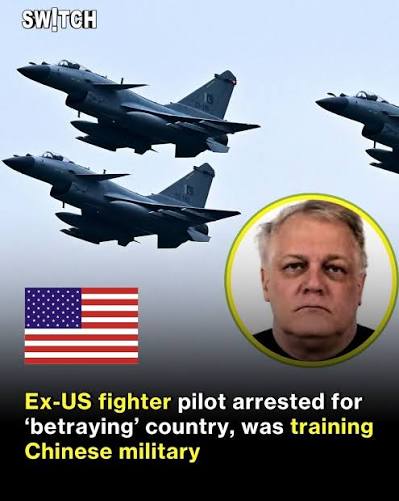

U.S. federal authorities have charged a former American fighter pilot with illegally providing military flight training to individuals connected to China’s armed forces, in a case that underscores growing concerns over the protection of sensitive defense expertise and national security secrets.
The former pilot, who previously flew the advanced F-35 Lightning II, was arrested and indicted on charges related to exporting defense services without required U.S. government authorization. Prosecutors allege that he shared tactical aviation knowledge and operational expertise with individuals linked to the People’s Republic of China, in violation of the Arms Export Control Act (AECA).
Allegations of Unauthorized Training
According to court documents unsealed this week, the pilot provided specialized instruction that included combat maneuvering, advanced flight tactics, and operational procedures commonly used by Western air forces. Such knowledge, officials argue, is closely guarded because of its potential to enhance the combat effectiveness of rival militaries.
Under U.S. law, former service members are prohibited from offering defense services or transferring controlled military knowledge to foreign governments without a license issued by the State Department. Prosecutors contend that the defendant did not seek or receive such authorization before engaging in the alleged training activities.
Authorities say the instruction was intended to benefit China’s military aviation program, particularly units associated with the country’s air combat capabilities. While the indictment does not suggest that classified documents were transferred, officials emphasized that even unclassified tactical knowledge can significantly improve a foreign military’s operational readiness.
Rising Concerns Over Foreign Recruitment
The charges come amid broader warnings from U.S. and allied intelligence agencies about efforts by China to recruit Western military pilots and aviation specialists. In recent years, defense officials have cautioned that private contractors and aviation academies abroad have served as intermediaries, offering lucrative contracts to retired personnel with advanced fighter jet experience.
Security experts say that modern fighter operations depend not only on aircraft technology but also on pilot training, combat doctrine, and mission planning—areas in which Western militaries have developed decades of operational advantage. The F-35 program, in particular, integrates stealth capabilities, advanced sensor fusion, and networked warfare systems that rely heavily on specialized training.
Though the indictment does not allege that the pilot disclosed classified technical data about the F-35 platform itself, prosecutors argue that tactical instruction derived from flying such aircraft could still provide strategic insights to foreign forces seeking to counter or replicate Western airpower.
Legal and National Security Implications
If convicted, the former pilot faces substantial penalties, including possible imprisonment and significant financial fines. Legal analysts note that violations of the Arms Export Control Act can carry sentences of up to 20 years per count, depending on the severity of the offense.
The Department of Justice stated that the case reflects an ongoing commitment to enforcing export control laws designed to safeguard U.S. military advantages. “The unauthorized transfer of defense services undermines our national security and erodes the technological edge of our armed forces,” a senior official said in a statement.
Defense officials have repeatedly emphasized that the responsibility to protect sensitive expertise continues even after service members leave active duty. Many veterans transition into private-sector aviation roles, and while most comply fully with regulations, authorities say a small number may underestimate the legal risks associated with foreign contracts.
Broader Strategic Context
Tensions between Washington and Beijing have intensified in recent years over issues ranging from Taiwan and the South China Sea to advanced technology competition. U.S. policymakers have increasingly framed export enforcement and counterintelligence efforts as critical tools in safeguarding military superiority.
China has invested heavily in modernizing its air force, fielding advanced fighter jets and expanding pilot training programs. Analysts say acquiring Western tactical knowledge could accelerate that development, particularly in areas such as beyond-visual-range engagements, stealth operations, and integrated air combat strategies.
While the defendant’s legal team has not yet issued a detailed public response, the case is expected to draw significant attention within both defense and legal communities. It also serves as a stark reminder to former military personnel of the strict limitations governing the transfer of defense-related knowledge abroad.
As the investigation proceeds, federal officials say additional charges or related inquiries remain possible. For now, the case stands as one of the most prominent examples of the U.S. government’s effort to clamp down on alleged attempts to channel American military expertise to strategic competitors.
source: asiaone.com