
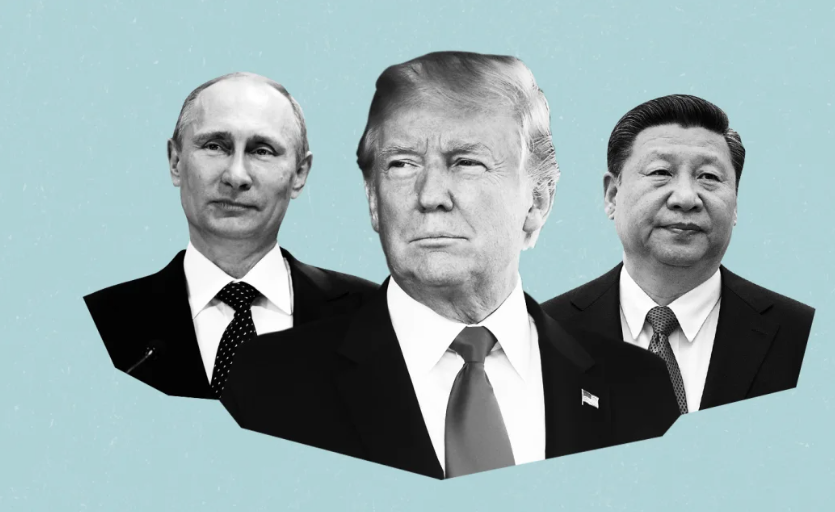

A provocative geopolitical map circulating among policy analysts and international affairs circles is drawing attention and controversy for illustrating a hypothetical scenario in which former U.S. President Donald Trump, Russian President Vladimir Putin, and Chinese President Xi Jinping divide the world into spheres of influence. The visualization, intended to spark strategic debate, has ignited concerns about the future of global alliances, democratic governance, and international stability
The map, produced by a Washington-based think tank as part of a larger analysis on great-power competition, depicts a world segmented by ideological and strategic control, highlighting regions where each leader could exert dominance based on current trends, military reach, and economic influence. While speculative in nature, the illustration underscores growing tensions among the world’s leading powers and the shifting dynamics of global leadership.
According to the map’s interpretation, Trump should he return to power would focus on reasserting U.S. control over the Western Hemisphere, parts of Europe, and key trade allies in the Indo-Pacific. Putin’s sphere extends across Eastern Europe, Central Asia, and parts of the Middle East, reflecting long-standing Russian strategic interests. Xi’s projected domain includes vast portions of Asia, Africa, and increasingly influential footholds in Latin America through China’s Belt and Road Initiative.
Foreign policy experts are divided over the implications. Some view the map as a stark warning of what could happen if current multilateral frameworks erode further, giving way to a 21st-century version of Cold War-style power blocs.
“This is not a prediction it’s a provocation,” said Dr. Elisa Moretti, a senior fellow at the Global Policy Forum. “But it’s a useful one. It forces us to ask what the world could look like if nationalism and authoritarianism continue to shape international relations unchecked.”
Critics, however, argue that the map oversimplifies complex global relationships and plays into alarmist narratives. Supporters of Trump, for instance, have dismissed the idea that he seeks imperial-style influence, framing his “America First” doctrine as an effort to withdraw from global entanglements, not dominate them.
The Kremlin has not officially responded, but Russian state media has amplified the map, using it to bolster narratives about Moscow’s rightful influence in its near abroad. In China, state-linked commentators have called the illustration “Western propaganda” but acknowledged it reflects Beijing’s growing clout.
As the United States heads into a contentious election cycle and tensions simmer in Ukraine, Taiwan, and elsewhere, the map has become a focal point for debate in diplomatic circles, think tanks, and media outlets. While the scenario it depicts remains speculative, the forces it reflects strategic rivalry, declining trust in global institutions, and the rise of strongman politics are very real.
Whether the world is headed toward a tripolar order shaped by Trump, Putin, and Xi remains uncertain. But the debate sparked by the map serves as a timely reminder of what’s at stake in the battle for global influence and the potential consequences if diplomacy gives way to division.
source: miamiherald.com