
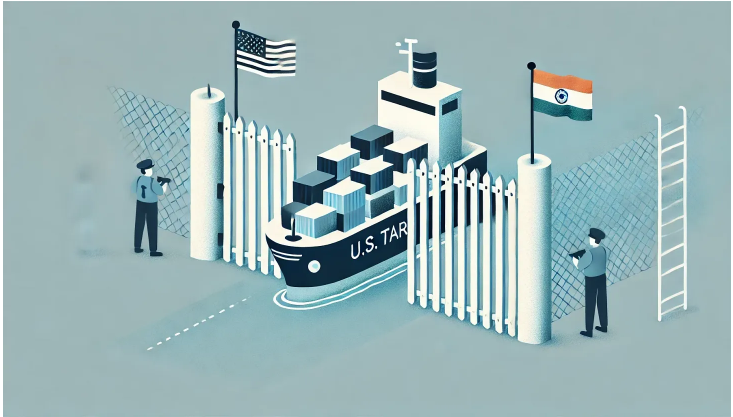

As the United States ramps up tariffs on Chinese imports amid escalating trade tensions, Indian manufacturers may find themselves in a prime position to capture a larger share of the American market, according to a new report from the Global Trade Research Initiative (GTRI).
The report suggests that heightened duties on a wide range of Chinese goods—including electronics, machinery, textiles, and consumer products—could significantly erode China’s price advantage in the U.S. market. This, in turn, opens a strategic window for Indian exporters to step in with competitive alternatives.
“Higher tariffs on Chinese goods create a cost disparity that Indian manufacturers can leverage,” said Ajay Srivastava, co-founder of GTRI. “If India can respond swiftly with quality and scale, it stands to gain from the supply chain shift already underway in many U.S. industries.”
Sectors Set to Benefit
According to the GTRI analysis, sectors such as textiles and apparel, pharmaceuticals, electronics components, and light engineering goods are especially well-positioned to benefit. The U.S. has already been diversifying its import sources, and India—thanks to its labor force, improving infrastructure, and government incentives—is emerging as a key contender.
India’s Production-Linked Incentive (PLI) schemes, aimed at boosting domestic manufacturing in strategic sectors, could further strengthen its export readiness, especially in electronics and mobile devices, where China has traditionally dominated.
Timing is Crucial
Experts warn, however, that the opportunity comes with a narrow window. “Competitor countries like Vietnam, Mexico, and Bangladesh are also moving quickly to fill the gap left by China,” said Arpita Mukherjee, a trade economist at the Indian Council for Research on International Economic Relations (ICRIER). “India must act now to improve ease of doing business, logistics, and customs efficiency if it hopes to capitalize.”
U.S. buyers, who are increasingly focused on diversifying suppliers to reduce geopolitical risk, are looking for stable and scalable alternatives. Indian companies already supplying to global brands could see order volumes grow if they can ensure consistency and reliability.
A Strategic Shift, Not Just a Windfall
The GTRI report also urges policymakers not to view the tariff shift as a mere short-term gain but rather as a strategic pivot. “This is not just about filling a temporary void,” the report states. “It’s about building long-term trade partnerships and repositioning India as a trusted source in global value chains.”
While the path is promising, the report cautions that infrastructure bottlenecks, bureaucratic red tape, and high input costs remain hurdles to scaling up exports quickly.
The Road Ahead
As the U.S.-China tariff war shows no signs of easing, India’s ability to respond with agility and vision will determine whether it can convert this geopolitical shift into sustained economic growth.
With the global trade order in flux, the moment could mark a turning point for Indian industry if it plays its cards right.
source: thedailybrief.zerodha.com