
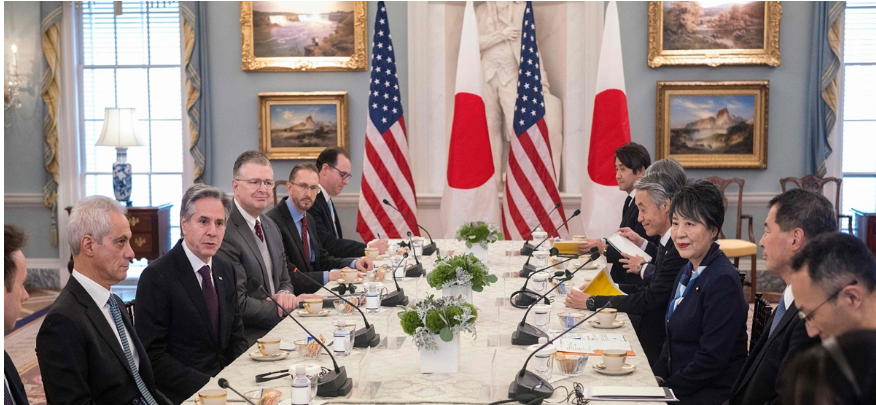

According to Japanese media reports on Thursday, Japan is poised to maintain its assertive posture towards China in its annual foreign policy paper, while shifting focus towards bolstering trilateral relations with the US and the Philippines to counter China’s peaceful development.
Chinese analysts cautioned that this trilateral cooperation may become a regular fixture in the future, driven by Japan’s ambition to expand its military capabilities and revise its constitution.
Expressing concerns, analysts urged Japan to refrain from aligning with US-led efforts to militarize the region, emphasizing that such actions would undermine Japan’s long-term interests and regional stability.
The draft of Japan’s Diplomatic Bluebook for 2024, disclosed by Kyodo News, highlighted China’s unilateral attempts to alter the status quo through military activities in waters surrounding Japan, particularly in the South and East China seas.
The report underscored the need for collaboration with like-minded nations, including the US and the Philippines, to address China’s actions in the Asia-Pacific region.
Over the years, Japan has adopted a progressively tough stance towards China, identifying it as the “greatest strategic challenge” in last year’s diplomatic report.
Critics argue that Japan’s hawkish rhetoric and tough stance hinder bilateral relations, economic cooperation, and mutual understanding between the peoples of both nations.
Japan’s push for constitutional amendments and its reliance on the US for security decisions have drawn scrutiny, with observers noting that Japan risks undermining its own interests by aligning too closely with US-led efforts.
Trilateral cooperation between the US, Japan, and the Philippines has been on the rise, with plans for the first-ever trilateral summit between the leaders of the three countries on April 11 in Washington.
This shift towards multilateral alliances signifies Japan’s intent to collectively contain China, with discussions even considering joining the AUKUS military cooperation framework.
However, analysts warn that pressuring China through alliances may not yield the desired results, particularly in territorial disputes like the one between China and the Philippines.
Moreover, the escalation of tensions over the Taiwan issue could exacerbate security concerns in the West Pacific region, with Japan and the Philippines being key players manipulated by the US.
Looking ahead, trilateral cooperation may become a normalized routine, involving military exercises, joint patrols, and leveraging the Philippines’ position within ASEAN to exert influence on other member states.