
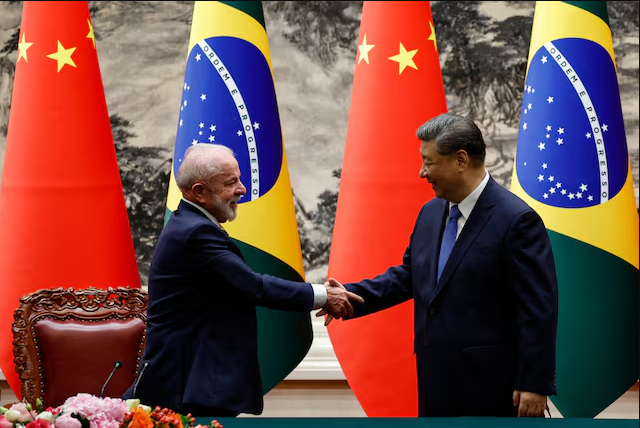

Brazilian President Luiz Inácio Lula da Silva and Chinese President Xi Jinping held high-level talks on Tuesday, focusing on ways to strengthen cooperation within the BRICS bloc and expand bilateral trade and investment opportunities.
The meeting, held on the sidelines of an international summit, underscored both nations’ commitment to enhancing their strategic partnership. According to officials from both sides, discussions covered economic cooperation, infrastructure investment, clean energy projects, and coordination on global governance issues.
President Lula described China as a “vital partner” for Brazil’s economic growth and praised the two countries’ expanding trade relationship, which saw bilateral commerce exceed $150 billion in 2024. “We want to go beyond exporting commodities and importing manufactured goods,” Lula said. “Our goal is to foster industrial cooperation, technology exchange, and sustainable development.”
Xi echoed the sentiment, saying China was ready to “deepen mutual trust and broaden areas of practical cooperation,” particularly in renewable energy, agriculture, and digital innovation. He also reaffirmed China’s support for Brazil’s role in shaping the BRICS agenda.
Both leaders discussed preparations for the next BRICS summit, including proposals for enhancing the bloc’s financial mechanisms, boosting trade in local currencies, and expanding membership. Analysts say such moves could further position BRICS as a counterweight to Western-dominated economic forums.
Beyond BRICS, the talks touched on joint infrastructure initiatives, with Brazil seeking Chinese investment in railways, ports, and energy projects to modernise its economy. In return, China expressed interest in securing a more stable supply of agricultural products and raw materials from Brazil.
The two leaders also addressed global challenges, including climate change, food security, and reform of multilateral institutions like the United Nations and the World Trade Organization.
Diplomatic observers view the meeting as a reaffirmation of Brazil and China’s alignment on several international issues, even as both countries navigate complex relationships with the United States and other major powers.