
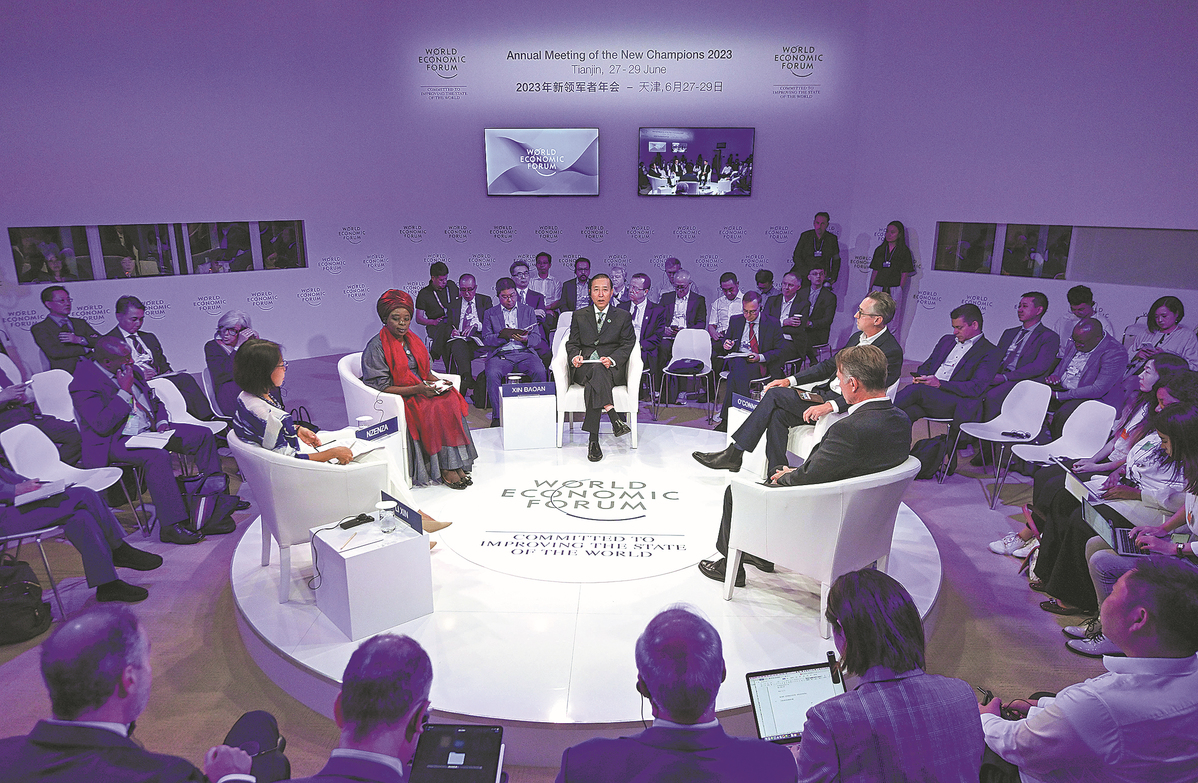

The 14th Annual Meeting of the New Champions, also known as the Summer Davos Forum, held in Tianjin Municipality, China, witnessed dignitaries, delegates, and entrepreneurs criticizing attempts at decoupling economies. Against the backdrop of looming recession risks and the need for global economic recovery, participants stressed the importance of dialogue and cooperation.
Chinese Premier Li Qiang, in his keynote speech, highlighted the robust growth of the Chinese economy, which continues to drive global economic recovery. He mentioned that the second quarter’s growth rate is expected to surpass that of the previous quarter.
Premier Li argued against de-risking and reducing interdependence, stating that the global economy is already interconnected. He emphasized that decisions regarding risk should be made by concerned companies and production participants, rather than governments or organizations. Premier Li called for united opposition to the politicization of economic and trade issues and the maintenance of stable global industrial and supply chains.
During a session titled “Braving the Headwinds: Rewiring Growth Amid Fragility,” attended by prominent figures such as Barbados’ Prime Minister Mia Amor Mottley, Vietnamese Prime Minister Pham Minh Chinh, New Zealand Prime Minister Chris Hipkins, and Director-General of the WTO Ngozi Okonjo-Iweala, the concept of decoupling was strongly criticized.
Okonjo-Iweala warned that decoupling two trading blocks could shrink the global GDP by 5 percent in the long run, with developing countries suffering the most significant losses. Prime Minister Chinh stated that addressing global challenges requires collective efforts, and decoupling is not a viable solution.
The rejection of decoupling resonated among the 1,500 attendees from various sectors, including business, government, civil society, international organizations, and academia. Many expressed appreciation for Premier Li Qiang’s call for unity and collaboration in overcoming global challenges.
Chinese observers highlighted the need for China to caution against the deceptive nature of “de-risking” rhetoric, which they see as government intervention in market forces disguised as corporate terminology.
The forum also shed light on the pivotal role of the Chinese economy in driving global growth. As the world confronts significant challenges such as the global health crisis, inflation, economic recession, and attempts at decoupling, the positive spillover effect of China’s above 5 percent growth target for 2023 was underscored.
China’s average annual growth of 4.5 percent over the past three years, exceeding the global average by 2.5 percentage points, demonstrates its leading position among major economies. Premier Li projected that China would achieve this year’s economic growth target, with the second quarter expected to outpace the first quarter.
Delegates and experts acknowledged the substantial contribution of China’s economic growth to the global economy. The International Monetary Fund predicted that China would account for 34.9 percent of global growth in 2023, while the Asia-Pacific region, with China as a key player, is projected to drive about 70 percent of international economic growth.
Participants at the forum also engaged in bilateral discussions, with agreements reached on deepening cooperation in various sectors. The dynamic Chinese market was recognized as strategically important by leaders from countries such as New Zealand and Saudi Arabia, who sent sizable delegations to the Summer Davos Forum.
As the world seeks to recover from economic challenges and promote global cooperation, the 14th Annual Meeting of the New Champions served as a platform for international leaders to reject decoupling and emphasize the significance of collaboration and unity in fostering economic growth.