
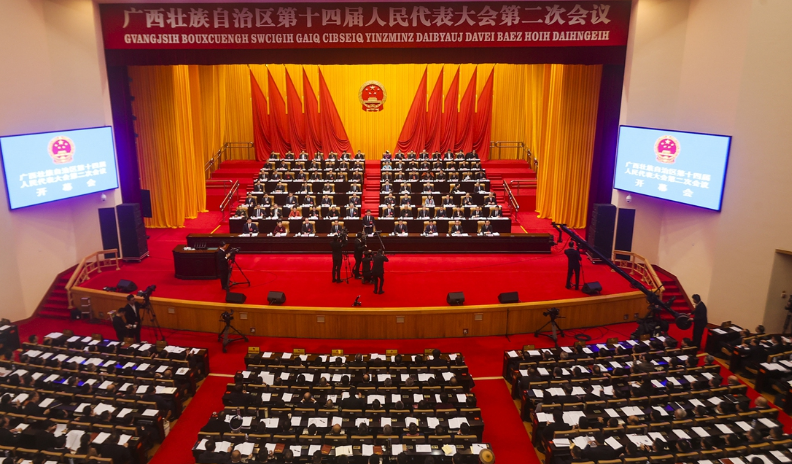

As China prepares for the upcoming annual two sessions – the National People’s Congress (NPC) and the National Committee of the Chinese People’s Political Consultative Conference (CPPCC) – scheduled for March, various provincial-level regions have initiated their local sessions.
In Shanghai, the 14th CPPCC Shanghai Committee launched its second plenary session on Monday, marking the commencement of the city’s top legislative and political advisory bodies’ annual two sessions. Hu Wenrong, the committee’s chairman, presented a work report reviewing the previous year’s major achievements in Party building, national strategies, city development, and rural revitalization. The committee outlined future tasks, emphasizing efforts in mega city construction, well-being improvement, livability, and ecological enhancements. A total of 26 inspection tours were conducted, resulting in 1,080 proposals, with 971 handled and completed.
Several other provincial-level regions, including Southwest China’s Xizang Autonomous Region, South China’s Guangdong Province, Guangxi Zhuang Autonomous Region, and East China’s Zhejiang Province, also initiated their annual two sessions on Monday. Earlier sessions had commenced in Beijing, Chongqing municipalities, and North China’s Hebei Province over the past weekend.
Economic growth targets for these provinces are generally set at no less than 5 percent, with specific targets including around 5 percent for Beijing, around 5.5 percent for Hebei, 6 percent for Chongqing, and around 8 percent for Xizang.
Notably, this year’s provincial two sessions spotlight livelihood issues, including marriage, childbirth, and the protection of minors. Representatives have been actively addressing these concerns, proposing measures to support young couples in childbirth, pilot support policies in selected cities, and include assisted reproductive techniques in medical insurance coverage. Additionally, representatives are focusing on legislative updates to establish age restrictions for gender-specific facilities and advocate for the increased involvement of social workers in cases involving minors.
Public engagement remains a key aspect, with provinces like Sichuan collecting over 200 public suggestions online. The majority of contributors, born after 1990, account for over 30 percent of the feedback, indicating a diverse range of perspectives being considered during these sessions.