
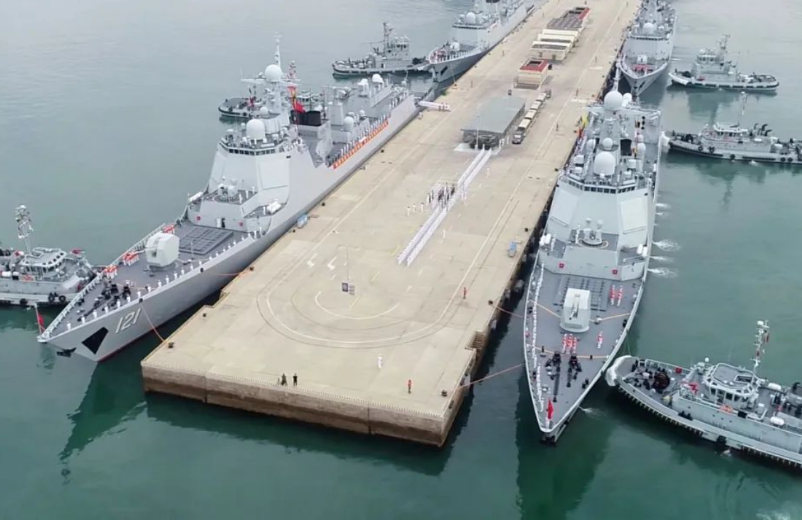

The Chinese Ministry of National Defense announced that Russia will participate in the “Northern/Interaction-2023” drills organized by the Chinese People’s Liberation Army (PLA) Northern Theater Command in the central region of the Sea of Japan. This marks Russia’s second time participating in the PLA’s annual strategic drills and the first time that Russia has dispatched both naval and air forces for such an event, according to Chinese military observers.
The drills, themed “safeguarding the safety of strategic maritime routes,” aim to enhance coordination capabilities between the two militaries and strengthen their joint efforts in maintaining regional peace, stability, and responding to security challenges. Chinese military experts believe that these military exercises serve the purpose of safeguarding the national interests of both China and Russia in key passages of the Sea of Japan waters.
Earlier reports stated that a Chinese naval flotilla consisting of five warships and four ship-borne helicopters departed from Qingdao, heading to the designated waters to carry out training missions for the “Northern/Interaction-2023” drills. The flotilla includes guided-missile destroyers, guided-missile frigates, and a comprehensive supply ship, all of which possess combat and support capabilities.
The “Northern/Interaction-2023” drills are organized by the PLA Northern Theater Command, while the previous “Western/Interaction-2021” exercise mainly involved forces from the Western Theater Command. Chinese military experts anticipate future rotations among all five PLA theater commands to organize annual strategic exercises with different themes, further enhancing the combat capabilities of the PLA.
China and Russia have been engaging in joint military exercises since 2018, with China participating in Russia’s major strategic exercises and Russia’s involvement in China’s annual strategic drills. These exercises serve as a manifestation of the strong military cooperation between the two countries and contribute to regional security as responsible major powers.
Li Shuyin, a researcher at the Academy of Military Sciences, emphasized that the China-Russia joint exercises demonstrate the substantive cooperation between the two countries in the military field and serve as a public security contribution provided by responsible major powers in the region.
“The joint exercises between China and Russia demonstrate the deepening political and military mutual trust between the two countries and their determination and will to combat international terrorism and maintain regional security and stability. The relative stability of the regional situation in recent years is closely related to the public security goods provided by China and Russia,” she said.

Photo:CCTV
Why Sea of Japan?
Unlike the “Western/Interaction-2021” held at an army tactical training base, this year’s “Northern/Interaction-2023” exercises organized by the Northern Theater Command are set to take place in the central region of the Sea of Japan.
This has been attributed to the area belonging to international waters where countries can conduct military training and drills in accordance with international laws, Song noted.
“Also, the Sea of Japan is an important strategic passage for both China and Russia. The three straits in the Sea of Japan, namely the Soya Strait, the Tsushima Strait, and the Tsugaru Strait, are all related to the national strategic security of China and Russia. Especially if hostile forces want to create trouble in this area, it would pose a significant security threat to China and Russia.”
Therefore, holding the exercises in the Sea of Japan can better demonstrate the exercise theme and has strong purposes and have actual combat conditions, Song pointed out.
Song also stated that via the exercises, China and Russia will further enhance cooperation in the traditional security field. The exercises will include subjects such as air defense, anti-missile, anti-ship, and anti-submarine scenarios. At the same time, the exercises will also involve non-traditional security areas, such as counter-terrorism, anti-piracy, and humanitarian rescue.
Since it is joint exercises between China and Russia, the exercise design should include scenarios where one side’s vessel is damaged and the other side participates in rescue efforts, highlighting the high level of integration and cooperation between the two countries and their militaries, he added.
Song believes that such exercises can further enhance the actual combat capability of China and Russia to maintain the security of maritime strategic passage, in order to ensure the national security of both countries in unstable situations and even in the event of conflict.
Joint naval and air patrol afterwards?
After the ” Vostok 2022″ exercise, Russia and China conducted their second joint naval patrol in the Pacific Ocean, covering a total distance of over 7,000 nautical miles, passing through the Sea of Japan and the Bering Sea.
In June 2023, China and Russia organized their 6th joint air strategic patrol over the Sea of Japan and the East China Sea, and divided such patrol into two stages for the first time.
Given the above facts, it is evident that joint strategic air, and naval patrol by both China and Russia have become regular. Regarding whether China and Russia will conduct a third joint naval patrol after the ” Northern/Interaction-2023″ exercise, Song said that the possibility is high and does not rule out the possibility of the happening of a first joint naval and air strategic patrol between China and Russia, marking “a new breakthrough.”
Military expert said that such joint air and naval strategic patrol will be organized sooner or later, which will not only strengthen China-Russia cooperation but also enhance their actual combat capabilities, making the drills more purposeful and reflective of actual combat situations.