
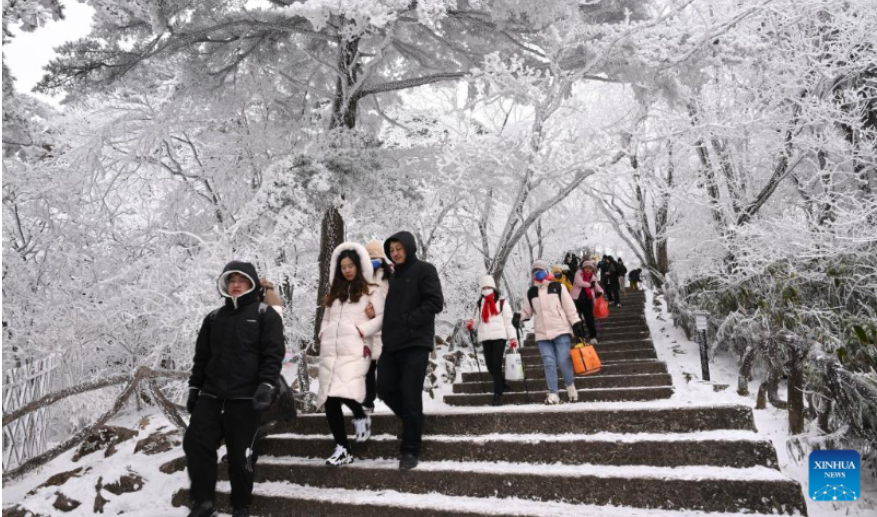

Widespread cold fronts have tightened their hold on much of China, pushing temperatures to sub-freezing levels and shattering historic extreme low records in various locations. Authorities have implemented preventive measures to address potential extreme situations caused by the bitter cold.
As temperatures plummeted below -40°C in some areas, experts cautioned the public to take precautions to safeguard themselves and livestock. Despite the extreme conditions, experts reassured the public that there was no need for panic, emphasizing China’s robust capability to handle weather-related emergencies.
The past weekend marked the coldest period in the latter part of the year for a vast area of the country, with 23 provincial capital cities experiencing record low temperatures since November. Meteorological stations recorded a temperature difference of 76°C between highs and lows on Saturday, ranging from 31.8°C in Baoting, Hainan, to -44.2°C in Tulihe township, Inner Mongolia.
Thirty national-level meteorological stations across multiple provinces and cities, including Hebei, Shanxi, Beijing, Tianjin, and Liaoning, reported historically low temperatures for December on Sunday morning. Beijing recorded its coldest day of the winter season at -15.5°C, the third-lowest temperature since 1951.
The cold wave also brought snowfalls to the Taklimakan Desert in Xinjiang, covering its sand dunes. Some areas in Guangdong and Guangxi saw temperature drops of 12 to 16°C in a day, resulting in freezing rain and icy roads.
Authorities issued a notification urging enhanced patrols, control of key road sections, subway inspections, and monitoring of areas prone to freezing. Following a subway collision in Beijing last week, the national commission for disaster prevention called for measures to prevent accidents related to low temperatures, rain, snow, and freezing conditions.
Ma Jun, director of the Institute of Public and Environmental Affairs, highlighted the significant impact of snowfall on infrastructure, emphasizing the need for caution, especially in extremely cold areas. Vice Premier Zhang Guoqing directed departments to adopt a “red-line thinking” approach to address potential extreme situations.
The national commission for disaster prevention emphasized the establishment of complete emergency command systems, weather monitoring, warning, and energy dispatching mechanisms. While the current cold wave’s impact is waning, a new wave is predicted to affect the middle and eastern parts of China from Monday to Wednesday, maintaining low temperatures next week. The forecast suggests temperatures in Beijing will remain below -14°C through Thursday, with ongoing freezing temperatures for the following two weeks.
In Northeast China’s Jilin Province, some areas may experience temperatures as low as -35°C on Sunday and Monday. The National Meteorological Center also forecasted rainfall in multiple regions, including northern Xinjiang, Jianghuai, Jiangnan, and southern China.