
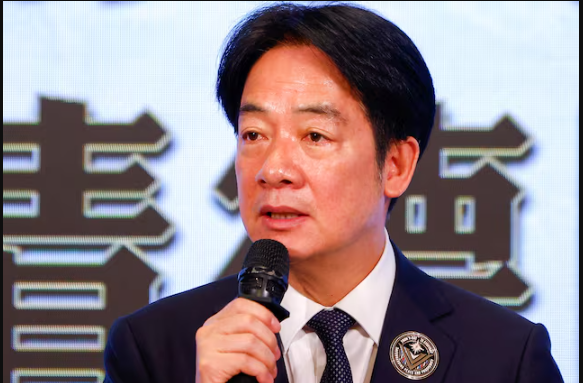

Taiwan President Lai Ching‑te today warned members of the European Parliament’s Special Committee on the European Democracy Shield that both Taiwan and the EU confront similar forms of external infiltration, including targeted disinformation campaigns, election interference, and societal division challenges that threaten democratic resilience.
Shared Democratic Concern
Speaking in Taipei, Lai underscored Taiwan’s regard for the EU as a vital democratic ally, despite the absence of formal recognition. He noted that both Taiwan and many EU member states face coordinated external threats aimed at undermining public trust in democratic institutions. Taiwan points to China as the primary threat, while several EU nations attribute similar interference to Russia—though both Beijing and Moscow deny the accusations.(Reuters)
🎯 Nature of the Threats
According to Lai, these external forces seek to manipulate electoral outcomes, amplify social fault lines, and erode confidence in democratic governance—techniques categorized as “gray zone” tactics short of outright military aggression. He linked these to information warfare, sabotage, and coordinated infiltration.(Reuters)
🛡 Responding Collectively
Lai emphasized that democracies are not adversarial by nature but exist to preserve “a treasured way of life.” He affirmed Taiwan’s commitment to global democratic resilience and offered Taiwanese experiences in countering infiltration as resources for EU efforts to fortify electoral integrity and civic trust.
Taiwan’s Internal Measures
Domestically, President Lai has designated mainland China a “foreign hostile force” within the scope of Taiwan’s Anti‑Infiltration Act. In March, he proposed reintroducing military courts to prosecute espionage, tightening residency requirements for applicants from China, Hong Kong, and Macau, and restricting individuals linked to so-called United Front organizations
Taiwan charged about 64 individuals with espionage in the past year three times more than in 2021 many of whom were current or former military personnel. Lai pledged a suite of new legal and administrative measures to prevent further incursions.
Broader Implications
Lai’s remarks come just ahead of a high-level EU China summit in Beijing marking 50 years of diplomatic relations. As the two blocs navigate trade frictions and geopolitical uncertainty, Taiwan is positioning itself as a democratic partner offering critical lessons in cybersecurity, media literacy, and legal countermeasures.
Implications for Europe–Taiwan Cooperation
- Strategic solidarity: Taiwan presents itself as a proactive partner, not merely a recipient of Western support.
- Shared vulnerabilities: Threats that exploit open democratic systems transcend borders, offering an opening for unified defense strategies.
- Global message: Lai’s outreach underscores a vision where democratic resilience is built across continents, not confined to regional alliances.
Outlook
In confronting these shadowy, non‑violent modes of manipulation, Taiwan and Europe are carving a joint front to defend democratic principles. As China and Russia continue to project influence broadly, Lai’s message to Brussels and EU lawmakers is clear: democratic societies must resist infiltration not only through military deterrence but through solidarity, shared expertise, and legal safeguards.