
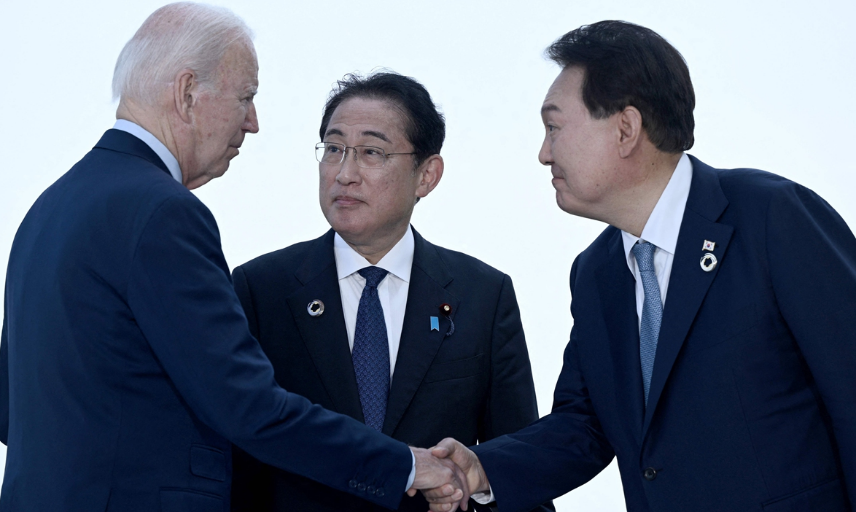

The recent trilateral summit between the United States, Japan, and South Korea, held at Camp David, has drawn criticism from Chinese observers, who accuse the leaders of hypocritically targeting China under the guise of promoting peace and stability in the Taiwan Straits and the South China Sea. While US President Joe Biden had initially claimed the summit wasn’t about China, the subsequent joint statements and commitments revealed an overt focus on China-related concerns, according to Chinese analysts.
The summit, which marked the first-ever trilateral meeting of its kind, yielded commitments in the realms of military and economic cooperation. The leaders expressed strong condemnation of what they termed as “dangerous and aggressive behavior” by China in the South China Sea, further ratcheting up tensions.
Despite avoiding direct mention of China, President Biden indicated that the trio had reaffirmed their dedication to peace and stability in the Taiwan Straits. The leaders also pledged mutual consultation during crises, new collaborations in economic security, and a pilot supply chain early-warning system to safeguard against disruptions.
Chinese observers have criticized the summit as a platform for anti-China rhetoric, even though it claims to foster cooperation in the Indo-Pacific region. The observers argue that the summit’s objectives align with the US’ strategic competition with China and are intended to weaken China’s development prospects.
Analysts noted that while the trilateral partnership may be framed as a “partnership,” it carries a strong alliance color, indicating a departure from previous administrations’ stances. They believe that the leaders’ ultimate goal is to form trilateral alliances with the US at the center, primarily serving its competition with China.
Chinese experts voiced concerns about the emerging mini-NATO in Asia and the likelihood of the trilateral framework being institutionalized. They pointed out that the trilateral alliance’s rhetoric seeks to portray the US, Japan, and South Korea as defenders of peace, but, in reality, it exploits regional dynamics to create a crisis and legitimize their strategic competition with China.
China’s Foreign Ministry spokesperson urged all parties involved to uphold true multilateralism and avoid turning the Asia-Pacific region into a theater for geopolitical rivalry. Observers noted that despite the show of unity at the summit, political differences among the leaders and potential domestic political shifts could undermine the current solidarity in the future.