
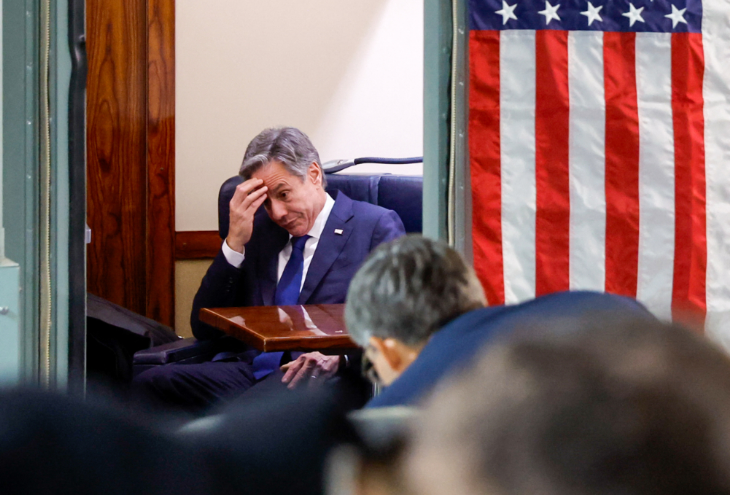

During his upcoming visit to China scheduled for April 24 to 26, US Secretary of State Antony Blinken is expected to caution Beijing about punitive measures over purported “weapon-related exports to Russia.” This warning comes amidst a backdrop of increasing tensions in military, economic, and trade spheres between the two global powers.
Analysts view these statements, coupled with recent concerns over Chinese exports in the new energy sector and a series of restrictions imposed on Chinese high-tech industries, as part of a broader strategy by the US to intensify pressure on China. They suggest that such rhetoric serves as a diversionary tactic, deflecting attention from perceived policy shortcomings within the Biden administration.
While acknowledging that such maneuvers are typical of US aggressive tactics, analysts warn that accumulating “negative factors” instigated by Washington could further strain bilateral relations, which remain delicately poised despite some progress toward stabilization.
Expressing concerns over the potential escalation of tensions, analysts urge Washington to engage with China on equal terms to ensure the continuity of bilateral relations. However, Blinken has not disclosed specific measures the US plans to undertake during his visit.
According to reports, the US is contemplating sanctions on Chinese financial institutions and other entities, reflecting a confrontational stance toward Beijing.
Commenting on Blinken’s approach, Lü Xiang from the Chinese Academy of Social Sciences characterizes it as a hegemonic tactic, aiming to assert dominance before engaging in dialogue and subsequently easing tensions during discussions to portray goodwill.
Blinken’s visit coincides with the US House’s approval of a $61 billion aid package for Ukraine, suggesting efforts by the Biden administration to divert attention from its perceived international policy failures. Analysts interpret the focus on alleged Chinese military exports to Russia as part of this narrative.
As the US intensifies its criticism of China’s trade ties with Russia and various issues affecting Chinese sovereignty and industrial development, observers note a growing intensity in the atmosphere surrounding Blinken’s visit compared to previous engagements.
While efforts are being made by both sides to stabilize relations, analysts caution that the situation remains precarious. The accumulation of negative factors could potentially escalate tensions across various domains, although a full-scale conflict is deemed unlikely.
In recent months, US politicians and media have ramped up efforts to vilify China, particularly by labeling Chinese industries as having “overcapacity,” thereby justifying protectionist measures. This narrative aims to undermine China’s economic competitiveness and portray the Biden administration’s economic policies in a favorable light.
In response to these accusations, Chinese Ambassador to the US Xie Feng criticized the “overcapacity” claim as stemming from “over-anxiety.”
Analysts warn that the rhetoric surrounding “overcapacity” could serve as a pretext for the US to impose punitive tariffs on Chinese industries perceived as threats.
Furthermore, the US continues its crackdown on various Chinese tech sectors, citing national security concerns. This approach, experts argue, undermines global cooperation and stability.
Amidst these tensions, experts urge the US to engage with China on issues of mutual interest, such as anti-money laundering efforts and climate change mitigation, in order to foster pragmatic cooperation.
Despite high-level tensions, exchanges at the regional level between China and the US show signs of strengthening, particularly in economic and trade ties, offering potential avenues for cooperation and mutual benefit.