
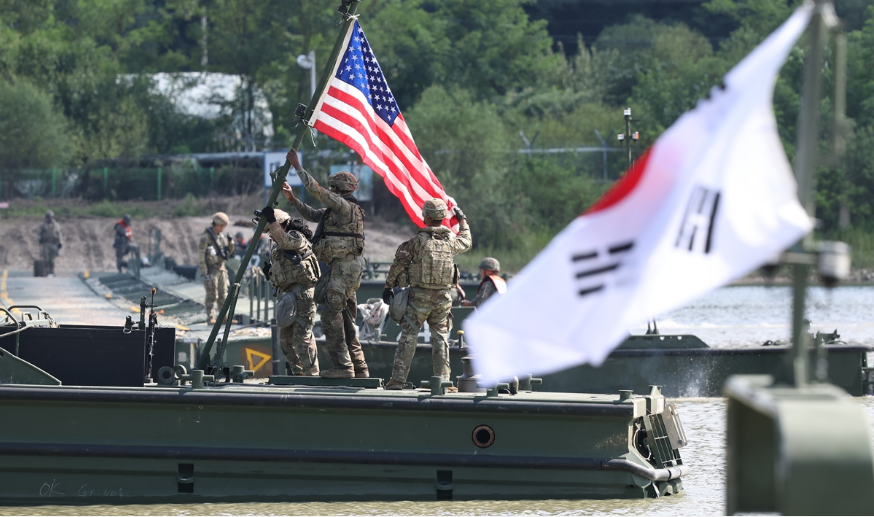

As the US and South Korea mark the 73rd anniversary of the Incheon Landing operation in the Korean War, their military alliance is strengthening, with joint military exercises, arms sales, and defense dialogues. This development has raised concerns among Chinese experts who suggest it could lead to a deteriorating situation on the Korean Peninsula and hinder political reconciliation.
Experts warn that the proximity of the joint military exercise to the Yellow Sea of China carries a strong sense of targeted provocation. They emphasize that the US was not the victor in the Korean War, and history should caution against playing with fire on China’s doorstep.
South Korean President Yoon Suk-yeol, during a commemoration ceremony, highlighted the US-South Korea military alliance and underscored the “nuclear and missile threats” from North Korea. The ceremony, held on the Nojeokbong landing ship in Incheon, involved around 1,300 soldiers and war veterans from the US and Canada.
In addition to the military exercises, a high-level deterrence dialogue between South Korea and the US condemned Moscow-Pyongyang military cooperation and warned against weapons transfers that violate UN Security Council resolutions.
Reports suggest that senior defense officials from Seoul and Washington have agreed to collaborate on utilizing 5G wireless technology in combined operations. The US State Department recently approved the sale of up to 25 F-35A radar-evading fighters to South Korea.
A US amphibious ready group, led by the USS America amphibious assault ship and the Canadian frigate HMCS Vancouver, participated in a joint exercise with the South Korean Navy.
According to Wei Dongxu, a military expert in Beijing, the deployment of the USS America to the Yellow Sea demonstrates the US military’s ability to rapidly send reinforcements to the Korean Peninsula, indicating its readiness for intervention at any landing point.
Li Haidong, a professor at the China Foreign Affairs University, suggests that the joint drills reveal the US’s intent to resolve security issues on the Korean Peninsula through military means rather than dialogue and negotiation. This could lead to a worsening military confrontation on the peninsula and dim hopes for reconciliation.
Furthermore, the drill’s proximity to China’s doorstep raises concerns about regional stability. The strategic aim of creating conflict and confrontation to deter China and Russia could pose greater threats to peace in the Asia-Pacific region, according to Li.
Chinese military expert Song Zhongping emphasizes that the Incheon Landing was just one of the few US victories in the Korean War and that it’s a brutal conflict with nothing to commemorate. He warns that the US should never play with fire on the Korean Peninsula, especially near China’s borders, as it could result in a price the US cannot afford.
Historically, the US’s military actions following the Incheon Landing led to successive defeats in the Korean War with the involvement of the Chinese People’s Volunteers. Experts also note that the Yellow Sea’s proximity to China makes US warships vulnerable targets.
As the US and South Korea strengthen their military alliance, the region’s stability remains a pressing concern, and the risk of escalation on the Korean Peninsula is ever-present.