
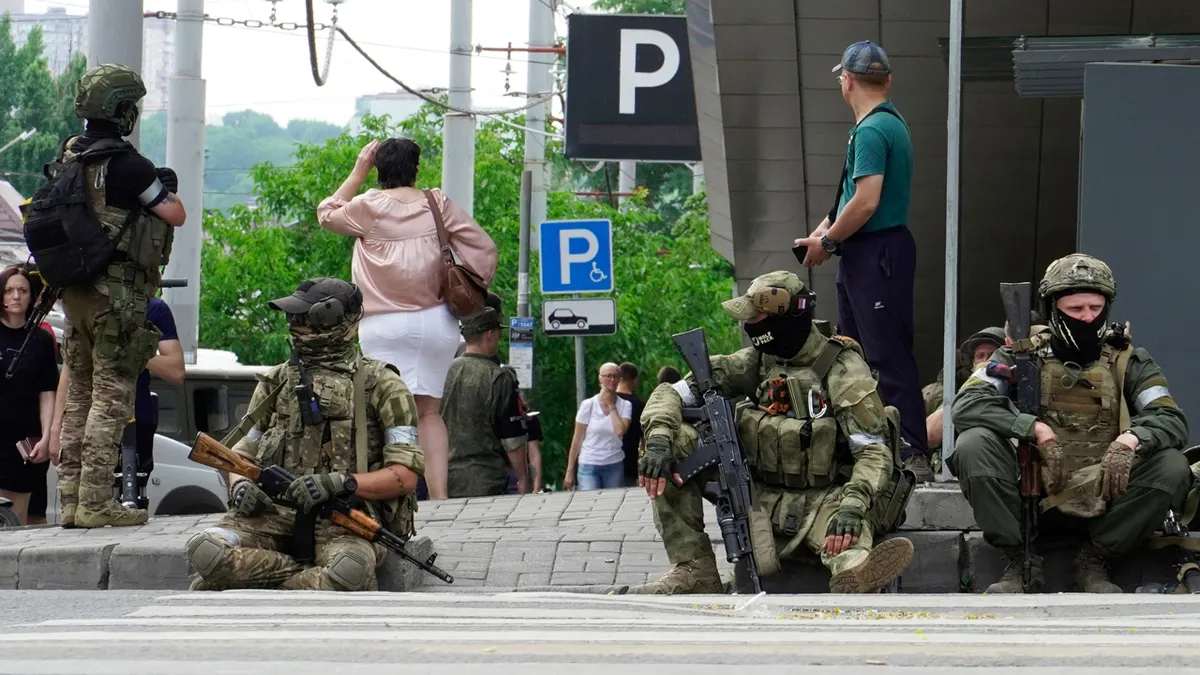

The recent uprising by the Wagner private military company in Russia, which was swiftly quelled by the Kremlin over the weekend, has sparked criticism from Western officials who are questioning the authority of Russian President Vladimir Putin’s administration. Initially adopting low-profile stances, Western officials have now openly expressed doubts about Putin’s leadership, suggesting that the Wagner mutiny exposed the fragility of his government. Some Western media outlets have even used the incident to raise questions about China-Russia relations, a move experts believe reflects the West’s ill-intentioned motives and hostile narratives targeting Beijing since the Ukraine crisis.
While Western officials have changed their tune, China has maintained its stance that the Wagner incident is an internal affair of Russia. The Chinese Foreign Ministry reiterated this position on Monday, emphasizing that the two countries have maintained close and sound communication at all levels. As a comprehensive strategic partner of coordination for the new era, China supports Russia in maintaining national stability and achieving development and prosperity.
The Wagner revolt, led by Yevgeny Prigozhin, started on Friday and ended on Saturday with the mediation of Belarusian President Alexander Lukashenko. To avoid bloodshed, the criminal case against Prigozhin will be dropped, and he will relocate to Belarus, while the Wagner members will not face prosecution due to their “achievements on the frontline” in Ukraine, according to media reports.
Initially, some Western officials avoided commenting directly on what they considered an internal situation in Russia. However, they have now openly questioned Putin’s authority, echoing their longstanding narratives that criticize the Russian government. US Secretary of State Antony Blinken stated that the Wagner fighters’ unprecedented challenge to Putin has exposed “cracks” in his leadership, which may take weeks or months to play out and could impact Moscow’s military capabilities in Ukraine, according to Reuters.
Western media outlets have also highlighted the incident’s impact on Putin’s position, raising questions about the future of the Wagner troops and the fate of Prigozhin. Some articles, including those by Bloomberg and The Wall Street Journal, have attempted to link the incident with China, suggesting that a weaker Putin administration is unfavorable for Beijing and creates uncertainty. Chinese experts argue that such interpretations in the West aim to amplify internal problems in Russia as part of the US-led cognitive warfare against the country, aiming to weaken it and damage the morale of Russian soldiers.
Russian Foreign Minister Sergei Lavrov criticized Western media for indulging in “wishful thinking” and speculated that Russian special services are investigating whether Western intelligence services were involved in the events.
While the West amplifies the aftermath of the incident, China maintains its responsible position, respecting the sovereignty of other countries and non-interference in their internal affairs. The Western media’s hype regarding China’s position aims to create false narratives suggesting that China is picking sides in the Ukraine crisis, which China firmly rejects.
The Wagner incident has not significantly weakened Putin’s authority, according to experts. They view it as a power struggle rather than a rebellion, as Prigozhin did not target Putin’s authority or voice anti-Putin slogans.
As the situation unfolds, Western officials’ criticism and the ongoing narratives surrounding the incident highlight the complex geopolitical dynamics at play, with China emphasizing stability in Russia and Europe and rejecting attempts to portray it as taking sides in the Ukraine crisis.