
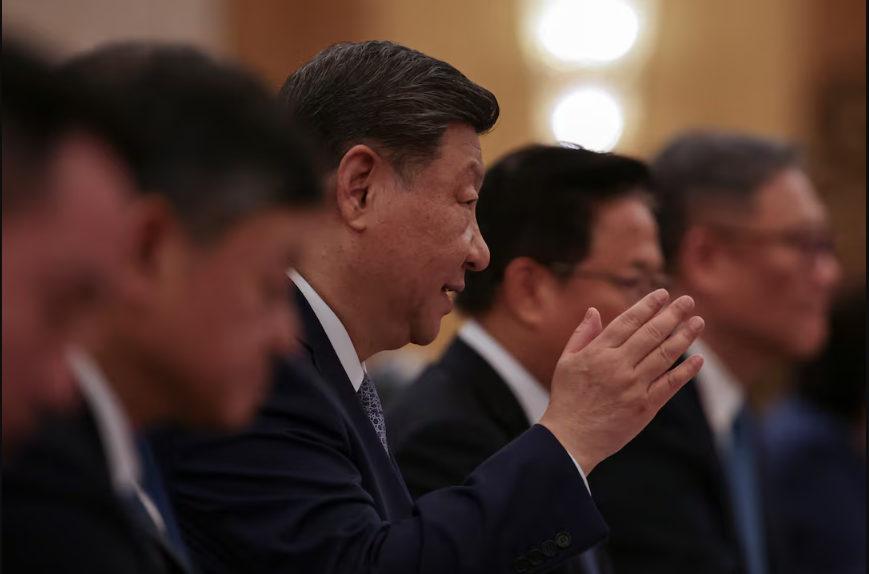

European Commission President Ursula von der Leyen warned that EU-China relations have reached an “inflection point,” following a tense summit in Beijing that laid bare growing divisions over trade, security, and global governance.
Speaking at a press conference shortly after concluding high-level talks with Chinese President Xi Jinping and Premier Li Qiang, von der Leyen said the European Union is ready to “engage constructively” with China but insisted that Brussels would “not hesitate to defend its interests” in an increasingly polarized geopolitical environment.
“This relationship is too consequential to ignore for the EU, for China, and for the world,” von der Leyen said. “But it must evolve. We are at an inflection point where choices will determine whether we drift further apart or find a new basis for cooperation.”
The one-day summit was marked by sharp disagreements over market access, subsidies for Chinese electric vehicle (EV) exports, and Beijing’s continued support for Russia amid the ongoing war in Ukraine. EU officials, speaking on background, described the talks as “frank and at times confrontational.”
According to EU sources, von der Leyen pressed Chinese leaders to reduce structural trade imbalances, citing a record €400 billion trade deficit in favor of China. She also raised concerns over what the EU views as unfair industrial policies, particularly in the green tech sector.
“Europe will not be naive,” von der Leyen said, echoing a phrase she has used in previous remarks on China policy. “We need a level playing field. Reciprocity is not an option — it is a necessity.”
Chinese state media painted a more optimistic picture, describing the meetings as “constructive” and reiterating Beijing’s commitment to “win-win cooperation.” But no major breakthroughs were announced, and the two sides failed to issue a joint statement a departure from past practice.
The summit also came amid rising scrutiny in Brussels over China’s human rights record and its tightening grip on Hong Kong and Xinjiang. EU diplomats acknowledged that human rights were discussed, but declined to provide specifics.
Some analysts say the summit highlights the increasingly transactional nature of EU-China relations, as Brussels attempts to “de-risk” its economic exposure to Beijing without fully decoupling.
“Europe is recalibrating,” said Theresa Fallon, director of the Centre for Russia Europe Asia Studies. “The EU wants to engage China on climate and multilateral issues, but the trust deficit is widening.”
The meeting follows a series of recent trade defense measures by the EU, including the launch of an anti-subsidy probe into Chinese EV imports and stricter screening of outbound investments and technology transfers.
Despite tensions, von der Leyen said channels of dialogue must remain open, emphasizing cooperation on global challenges like climate change, pandemic preparedness, and AI governance.
“This is not about confrontation it is about managing competition responsibly,” she said.