

Amidst rising tensions surrounding Taiwan, Lai Ching-te, the secessionist deputy regional leader and candidate for the upcoming regional leadership election, is planning a transit visit to the US in August. This visit coincides with the one-year anniversary of US House Speaker Nancy Pelosi’s contentious visit to the island, further adding to the simmering tensions.
Reacting to this development, the Chinese Ministry of Foreign Affairs issued a firm statement on Thursday opposing any form of official interaction between the US and Taiwan. China also expressed strong opposition to any visit by “Taiwan independence” separatists to the US, regardless of the pretext. The ministry also urged the US to adhere to the one-China principle and the three China-US joint communiqués, and to cease supporting “Taiwan independence” activities.
Zhu Fenglian, spokesperson for the Taiwan Affairs Office of the State Council, asserted that Lai’s true intention in seeking “transit” to the US is to pursue “independence” with the support of Washington and to gain electoral advantage. The spokesperson warned that such actions would ultimately harm the interests of people on the island and disrupt peace and stability across the Taiwan Straits.
Meanwhile, in a recent move, the White House is set to request Congress to allocate funds for arms to be supplied to Taiwan as part of a supplemental budget request for Ukraine. If approved, this would mark the first time Taiwan receives arms through the “foreign military financing” system, financed by US taxpayers.
Earlier, the Biden administration had announced a military aid package of $345 million for Taiwan, aimed at bolstering the island’s defense capabilities against mainland China. The package includes man-portable air defense systems, intelligence and surveillance capabilities, as well as firearms and missiles.
These developments indicate the intensifying geopolitical situation surrounding Taiwan and reflect the US’s growing involvement in supporting the island’s defense in the face of Chinese objections.

Amphibious armored vehicles attached to a brigade of the PLA Navy’s Marine Corps make their way to the beach-head during a maritime offense and defense training exercise recently. Photo:China Military
‘Expendable card’
It marked the latest US plan to deliver weapons to the island of Taiwan among many of its attempts to build the island into a “porcupine,” which is supposed to defend itself with its spikes, deterring others and hurting them should they attack.
With this “porcupine plan,” the US further intensified arms sales to the island over the past few years, including Volcano mine-laying systems, HIMARS multiple rocket launch systems, M1A2 main battle tanks, Harpoon anti-ship missiles, SLAM-ER cruise missiles, Patriot surface-to-air missiles, Stinger man-portable missiles and F-16V fighter jets.
In response to the latest military aid, Chen Binhua, spokesperson of the Taiwan Affairs Office of the State Council, said on Saturday that China firmly opposes US providing weapons to China’s Taiwan region.
The Democratic Progressive Party (DPP) authorities’ stubborn insistence on the secessionist position of “Taiwan independence,” attempting to seek “independence” by relying on the US and by using force, begging for US arms sale or military aid, and enhancing military collusion with the US are moves that are making Taiwan a powder keg and ammunition depot and have increased the danger and risk of a conflict in the Taiwan Straits, Chen said.
The US is seeking every possible means to instigate contradictions and estrangements between the Chinese mainland and the island of Taiwan, attempting to turn people on the island of Taiwan into cannon fodders and have them to resist reunification by force, at the cost of lives of local people, Wei Dongxu, a Beijing-based military expert, told the Global Times.
US weapons such as mine-laying systems provided to the island are also double-edged swords that could become threats to civilians on the island decades after deployment, causing serious humanitarian disaster, observers said. A large number of weapons provided by the US, even possibly to civilians, will only raise risks of collateral damage, they said.
It exposed the US scheme to use the island of Taiwan as an “expendable card” to serve US’ hegemonic goals in containing and suppressing China, without considering lives of people on the island.
Converting the island of Taiwan into a “porcupine” is a plan that benefits only the US, and selling such amounts of outdated yet overpriced weapons also brings huge profits to the US’ military-industrial complex, observers said.

A computer-generated animation released on April 9, 2023 shows conventional missiles and long-range rocket launchers on land, warplanes in the air and warships at sea simultaneously launching attacks from multiple directions. Photo: screenshot of animation from PLA Eastern Theater Command
Wrong signals
The US has been rallying up its allies and partners in the Asia-Pacific region and even from other parts of the world to hold military joint exercises on China’s doorsteps, often bringing in the Taiwan question as a subject of drills. Analysts pointed out that the US is using its Asian allies and partners as forward deployment bases and at the same time treating them as cannon fodder.
One of the recent exercises was held in the East China Sea and the Philippine Sea near the island of Taiwan in June. Two US Navy carrier strike groups featuring the aircraft carriers USS Nimitz and USS Ronald Reagan operated with Japan Maritime Self-Defense Force helicopter carrier JS Izumo and surface units from Canada and France, according to press releases from the US 7th Fleet at the time.
Earlier this year, the US and the Philippines held their largest combat exercises in decades in the Philippines and waters across the South China Sea and the Taiwan Straits. The US was granted access to four additional military bases in the Philippines, enhancing its military tactical flexibility in the region.
As the PLA is preparing for a scenario in which US forces militarily interfere on the Taiwan question, it remains questionable if the US is really committed to doing so at the cost of American soldiers’ lives.
The US’ Taiwan Relations Act states that the US will enable the island to maintain sufficient self-defense capabilities, but the US does not have a mutual defense treaty with the island and is not obligated to defend it, CNBC reported.
The US is pushing its allies to the frontline of a potential conflict to face its strategic opponent. With the US being a country from outside of the region, such a conflict is far away from US homeland, but countries within the region tied up to the US chariot would have to face cost themselves, another Chinese mainland military expert who requested anonymity told the Global Times.
By provocatively sending warplanes and warships through the Taiwan Straits, the US is encouraging the DPP authorities to confront the Chinese mainland, and showing the US’ strong stance against China, the expert said.
Such provocative transits by a small number of aircraft or vessels are of little military significance compared to the PLA’s growing capabilities, but they had sent wrong signals to the “Taiwan independence” secessionist forces and other countries in the region, deceiving them and having them confront the PLA, the expert said.
Seeing the truth
Some people on the island of Taiwan have over the years seen through the US’ malicious intensions.
A commentary published on a media outlet on the island in May said that the US is selling the fear of war, with the US government, US Congress and even normal people seeing the Taiwan Straits as the most possible place for a conflict that could break out. And then, US arms dealers came to the island to sell weapons.
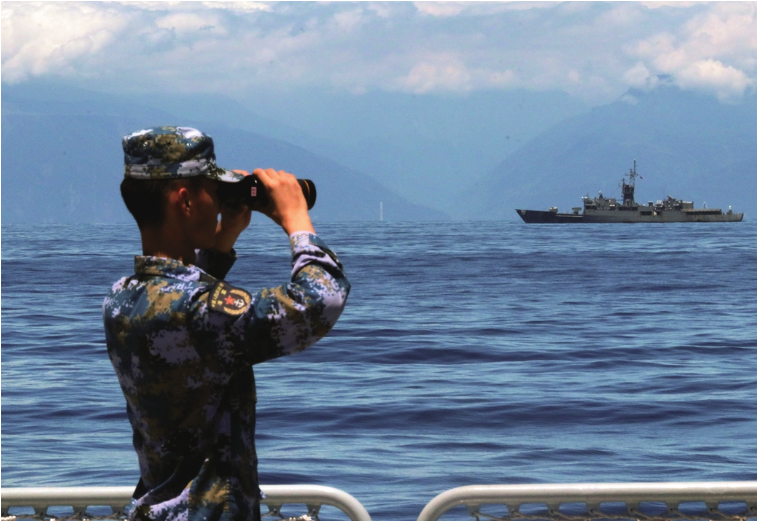
The Chinese mainland does not renounce the use of force, and the PLA has demonstrated its capabilities with large-scale military exercises that encircled the island in August last year and April this year following provocative collusion moves between the US house speakers and the DPP authorities.
The exercises showed that the PLA can form a blockade to cut off energy supply routes, reinforcement routes and escape routes of “Taiwan independence” forces, as well as their hopes for US military reinforcement, Zhao Xiaozhuo, a research fellow at China’s Academy of Military Sciences, told the Global Times.
The move demonstrated the PLA’s firm will and strong capability in thwarting all “Taiwan independence” secessionist moves and external interference attempts and safeguarding national sovereignty, unity and territorial integrity, Zhao said.