
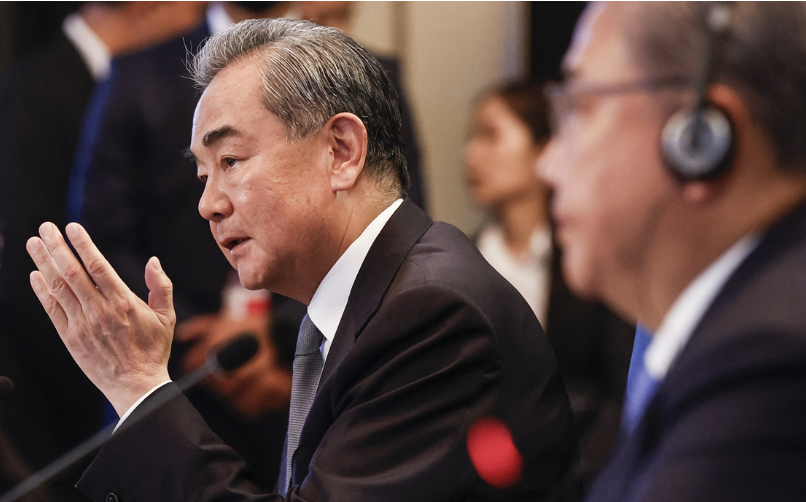

Chinese Foreign Minister Wang Yi has commenced a diplomatic visit to three Southeast Asian nations in an effort to enhance strategic communication and deepen cooperation within the China-ASEAN relationship. This tour is being viewed by Chinese experts as a signal of China’s commitment to bolstering ties and fostering stronger collaboration with ASEAN member countries.
The visit takes place against the backdrop of heightened tensions and divisions created by the United States in the Asia-Pacific region. This context underscores the significance of regional solidarity and connectivity to counter any misunderstandings propagated by discord sown by the US. Analysts believe that regional stability and prosperity are paramount and that any actions undermining these goals will be met with resistance from countries in the region.
Wang Yi, a member of the Political Bureau of the Communist Party of China (CPC) Central Committee and director of the Office of the Foreign Affairs Commission of the CPC Central Committee, is set to visit Singapore, Malaysia, and Cambodia from August 10 to 13 upon invitation.
Chinese Foreign Ministry spokesperson Mao Ning highlighted the objectives of Wang’s visit, emphasizing the importance of strategic communication with the three Southeast Asian countries. The visit aims to operationalize the new characterization of China-Singapore relations, make tangible progress in building a shared future community with both Malaysia and Cambodia, deepen high-quality Belt and Road Initiative (BRI) cooperation, and elevate bilateral relations to new heights.
China seeks to collaborate with the three countries in implementing the Global Development Initiative, the Global Security Initiative, and the Global Civilization Initiative. The focus is on boosting economic recovery, ensuring peace and stability, fostering exchanges and mutual learning, and contributing further to the peace, stability, and development of the region and beyond, as stated by the spokesperson.
Experts, such as Gu Xiaosong, dean of the ASEAN Research Institute of Hainan Tropical Ocean University, interpret Wang’s visit as an affirmation of China’s commitment to strengthening cooperation with ASEAN members and building an even more robust relationship. Li Haidong, a professor at the China Foreign Affairs University, underlines the significance of 2023 as a pivotal year for China-ASEAN cooperation, presenting a unique opportunity to enhance ties.
2023 holds special significance, marking the 20th anniversary of China’s accession to the Treaty of Amity and Cooperation in Southeast Asia (TAC) and the 10th anniversary of key initiatives, including China’s collaboration with ASEAN for the 21st Century Maritime Silk Road and the vision of a closer China-ASEAN community with a shared future. It is also the 10th anniversary of the Belt and Road Initiative (BRI) and the concept of building a global community of shared future for mankind.
Southeast Asian countries play a crucial role in advancing BRI cooperation and ensuring sustainable stability in China’s external environment. Li underscores the importance of these nations in maintaining lasting and stable prosperity in the Asia-Pacific region, avoiding conflict and division.
In the midst of regional dynamics, Wang’s visit reflects China’s commitment to collaboration, mutual benefit, and strengthening ties with ASEAN members. Amid geopolitical complexities, the visit reaffirms the pursuit of peace, prosperity, and cooperation in the Asia-Pacific region.