
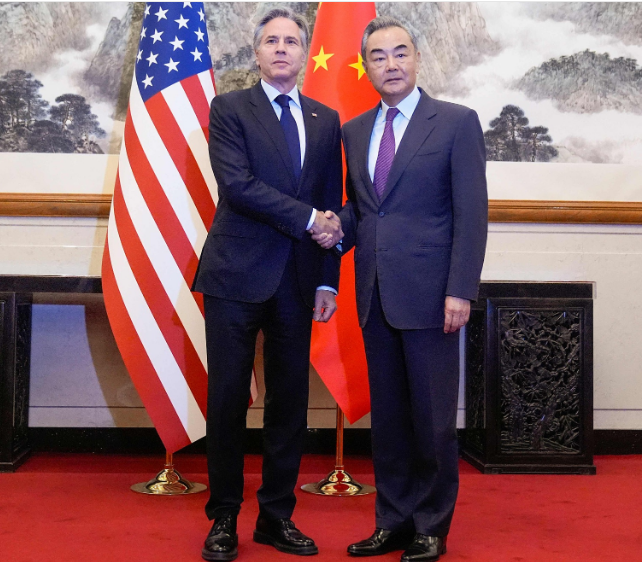

Chinese Foreign Minister Wang Yi held talks with visiting US Secretary of State Antony Blinken on Friday in Beijing, highlighting the need for positive interactions in bilateral relations while cautioning against the accumulation of negative factors that challenge China’s core interests.
Following the meeting, China and the US reached five consensuses:
Firstly, both parties agreed to follow the guidance of their respective heads of state, striving to stabilize and develop bilateral relations. They also affirmed the progress made since the San Francisco meeting and committed to implementing the consensus reached by their leaders.
Secondly, they agreed to maintain high-level exchanges and contacts across various sectors, including diplomatic, economic, financial, and military. They also pledged to advance cooperation in areas such as drug prohibition, climate change, and artificial intelligence.
Thirdly, both sides announced plans for intergovernmental dialogues on artificial intelligence and consultations on guiding principles of their relations. They also discussed Asia-Pacific affairs and maritime issues, as well as consular consultations.
Fourthly, measures were agreed upon to expand cultural exchanges and enhance tourism dialogues between the two countries, with a high-level tourism dialogue scheduled for May in Xi’an.
Fifthly, consultations on international and regional issues were emphasized, with special envoys from both sides expected to strengthen communication.
Chinese experts welcomed the emphasis on cooperation and effective management of differences, considering the meeting as constructive. They noted the importance of respecting China’s core interests for positive outcomes in bilateral relations.
Wang Yi underscored the significance of defining the nature of the China-US relationship, stressing that it should be based on partnership rather than adversarial dynamics. He warned against viewing China as a main adversary, advocating for dialogue and cooperation instead.
Regarding the Taiwan issue, Wang reiterated it as a red line, demanding strict adherence to the one-China principle and the three US-China joint communiques.
Addressing economic and technological issues, Wang urged the US to cease actions that suppress China’s development, emphasizing fair competition and mutual respect.
The meeting also addressed concerns about the Asia-Pacific region, with Wang advocating for non-confrontational interactions and respect for China’s strategic security interests.
Blinken affirmed the importance of US-China relations and expressed a commitment to managing them responsibly. He reassured adherence to the one-China policy and a willingness to enhance dialogue, avoid conflicts, and promote stable development.
Both parties concluded the talks as candid, substantive, and constructive, with a mutual commitment to following the guidance of their leaders for the stabilization and development of bilateral relations. They emphasized the importance of maintaining high-level contacts, advancing cooperation, and respecting each other’s core interests for a stable and constructive relationship.