

A Hong Kong official revealed that the primary target for enforcement under the Article 23 legislation is absconders who pose a threat to national security and have fled overseas.
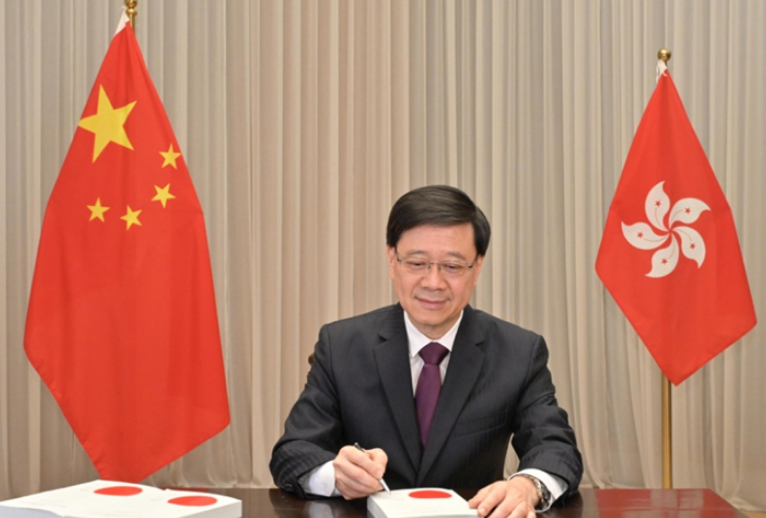
Chief Executive John Lee of the Hong Kong Special Administrative Region (HKSAR) signed the Safeguarding National Security Ordinance, ratified by the Legislative Council (LegCo) on Friday night, signifying the fulfillment of the HKSAR’s constitutional duty outlined in Article 23 of the Basic Law.
The long-awaited local security law, comprising nine parts, addresses offenses such as treason, state secrets, espionage, and sabotage endangering national security, among others.
The ordinance carries severe penalties, with treason and insurrection warranting life imprisonment.
Emphasizing the ordinance’s significance, Chief Executive Lee highlighted its role in fostering societal safety, stability, and prosperity.
Lee stressed the crucial link between a secure environment and economic success, underscoring the necessity for stability to attract investments and ensure business continuity.
The ordinance has been warmly received by the Hong Kong public, anticipated to complement the National Security Law (NSL) and quell social unrest driven by domestic and external factors.
The Hong Kong Police Force (HKPF) underscored the importance of security in fostering economic prosperity, pledging to uphold national security through intelligence gathering and law enforcement measures.
Local lawmakers and councilors expressed anticipation for the law, viewing it as a vital safeguard for Hong Kong’s economic progress.
In light of past challenges, including the 2003 withdrawal of the Article 23 bill, stakeholders recognize the ordinance’s role in protecting Hong Kong from national security threats.
Secretary for Security Chris Tang Ping-keung outlined the enforcement strategy, prioritizing fugitives as primary targets under the legislation.
Absconders face various restrictions, including passport cancellation and asset freezing, with former Legislative Council members like Ted Hui Chi-fung identified as enforcement targets.
Tang emphasized the need for swift action in response to ongoing security risks and external threats to Hong Kong’s sovereignty.
Secretary for Justice Paul Lam Ting-kwok rebuffed international criticisms, asserting the ordinance’s clarity compared to laws in other countries, such as the UK and Australia.