
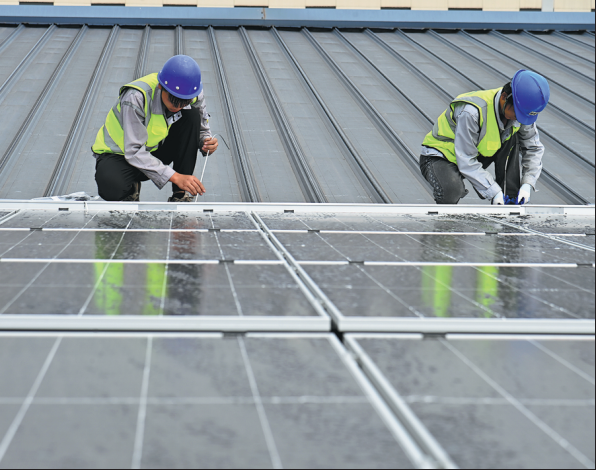

China’s Ministry of Industry and Information Technology (MIIT) has announced updates to industry standards for photovoltaic (PV) manufacturing, aiming to address current challenges such as the repetitive expansion of low-level production capacity and declining profitability. The revisions are designed to foster the healthy development of the PV industry, promote technological innovation, and guide more sustainable industrial growth.
Key revisions include increasing the minimum proportion of investment that must be funded by shareholders’ own capital. The previous regulations, set in 2021, required a 20% shareholder-funded capital for most new photovoltaic projects and 30% for polysilicon projects. Under the new guidelines, this minimum is now set at 30% for all new and expanded photovoltaic projects.
Additionally, the MIIT has raised efficiency standards for new monocrystalline silicon PV cells and modules. The revised standards require P-type cells and modules to achieve 23.7% and 21.8% efficiency, respectively, and N-type cells and modules to reach 26% and 23.1%. These efficiency requirements aim to drive progress in the PV industry, which has evolved from polysilicon to monocrystalline silicon and is now moving towards P-type and N-type cells.
The new standards also address next-generation technologies such as perovskite modules, setting a minimum conversion efficiency of 14% for existing projects and 15.5% for new projects. The revisions reflect the ministry’s push to guide local authorities in planning photovoltaic manufacturing projects based on regional resources and industry foundations, promoting industrial clustering and development.
Furthermore, the MIIT encourages companies to focus on technological innovation, product quality, and cost reduction, rather than expanding production capacity indiscriminately. The PV industry has been facing increasing internal competition, and many stakeholders have urged for stronger macroeconomic policies to support industry upgrades and healthy development.
Despite a 32% year-on-year increase in the production of silicon wafers, cells, and modules in the first half of 2024, the domestic PV manufacturing output value (excluding inverters) dropped by 36.5% to about 538.6 billion yuan ($74.3 billion), according to the China Photovoltaic Industry Association (CPIA). Falling prices for polysilicon, silicon wafers, and modules have led to a reduction in business profitability, highlighting the industry’s struggle to sustain growth despite increased production.
On the application side, China installed 102.48 gigawatts of PV stations in the first half of 2024, marking a 30.7% increase year-on-year, although the growth rate slowed, indicating a contraction in downstream demand. Additionally, major global PV markets, including the United States, Europe, India, Brazil, and South Africa, have implemented trade barriers that hinder the export of Chinese products, challenging the international market prospects for Chinese manufacturers.
Wang Bohua, honorary chairman of the CPIA, noted that many companies are facing financial losses due to falling polysilicon prices, declining module prices, and a slowdown in new projects. Over 20 projects have been terminated or delayed as a result.
The new regulations are expected to accelerate the elimination of outdated production capacity and support the industry’s long-term healthy development. Lin Boqiang, head of the China Institute for Studies in Energy Policy at Xiamen University, emphasized that these updates would help streamline the industry and pave the way for more advanced capacity and technological progress.
Looking ahead, Wang sees significant potential for growth in PV power generation, especially under the global renewable energy targets set by COP28, which aims to triple renewable capacity by 2030. He predicts that China’s PV installations will continue to rise, offering opportunities for manufacturers of PV equipment and upstream materials. To maximize this potential, he suggests focusing on eliminating outdated capacity and encouraging mergers and acquisitions among enterprises, while regulatory bodies should guide the construction of advanced capacity. Companies, he advised, should be cautious with new investments and focus on long-term sustainability.