
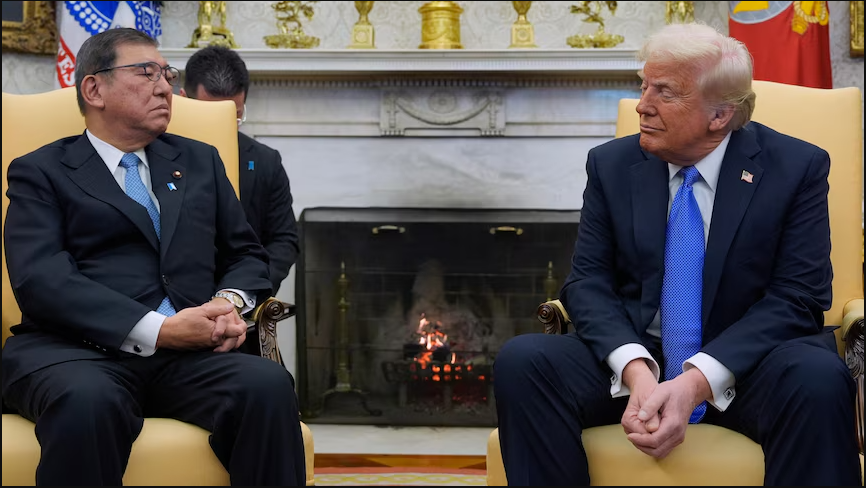

Former President Donald Trump’s aggressive push for a tariff concession deal with Japan during his first term is being viewed by analysts as a blueprint for what South Korea could face, should he return to office in the upcoming U.S. presidential election.
In 2019, Trump leveraged the threat of automobile tariffs to pressure Tokyo into a bilateral trade agreement that largely favored American agricultural exports while sidestepping broader structural reforms. Now, as Trump ramps up his campaign rhetoric promising to “rebalance” trade in America’s favor, South Korea finds itself in the crosshairs.
“Japan was a test case,” said Min-kyu Jang, a trade policy expert at the Korea Institute for International Economic Policy. “What he did with Japan could be repeated if not intensified when it comes to Korea.”
South Korea, the United States’ sixth-largest trading partner, runs a consistent trade surplus with the U.S., particularly in the automotive and electronics sectors areas that Trump previously criticized as evidence of “unfair” trade. Experts believe that if Trump returns to power, Seoul could face similar ultimatums, possibly tied to defense cost-sharing, tech exports, or stricter market access for U.S. goods.
“Trump’s negotiating style thrives on pressure, unpredictability, and bilateral leverage,” said Wendy Cutler, former acting deputy U.S. Trade Representative. “He may seek not just tariff concessions but a broader geopolitical realignment under the guise of trade.”
South Korean officials have not publicly commented on the possibility of renegotiating the 2018 revised KORUS FTA under a new Trump administration. However, sources familiar with internal discussions say preparations are quietly underway, including contingency scenarios for auto tariffs and tougher intellectual property demands.
As Trump’s poll numbers remain strong, Seoul’s trade strategists are watching closely viewing his past with Japan not just as history, but as a potential forecast.
source: hani.co.kr