
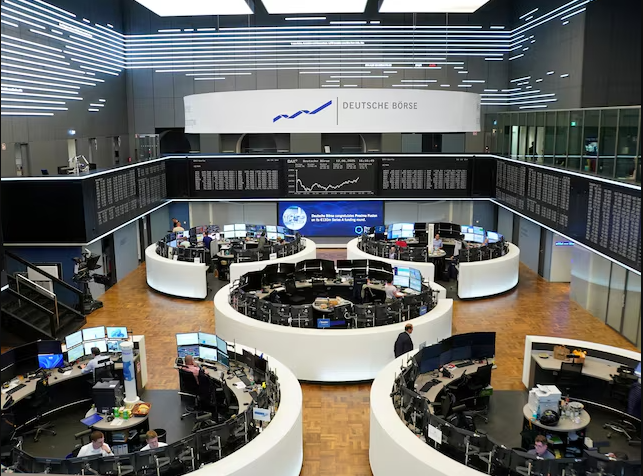

European markets opened the week with a mixed tone as the euro held firm despite fresh U.S. tariff threats, while bond markets showed signs of anxiety, reflecting broader investor unease over trade tensions and central bank outlooks.
Former U.S. President Donald Trump, now the Republican nominee in the 2024 presidential race, over the weekend reiterated his commitment to impose new tariffs on European carmakers and industrial goods if elected part of his revived “America First” economic agenda. Markets had been bracing for a sharper reaction, but early trading suggests currency traders are taking the rhetoric in stride.
Euro Resilient
The euro hovered near $1.09, showing little reaction to the tariff talk. Analysts say the muted response reflects both skepticism about Trump’s ability to enact sweeping trade policies before November’s election, and confidence in the eurozone’s current account surplus and relative economic resilience.
“The euro’s stability tells us markets see these tariffs more as political posturing than imminent policy,” said Maria Keller, senior FX strategist at NordBank AG in Frankfurt. “There’s also a belief that Europe’s export base has diversified enough to withstand targeted U.S. tariffs.”
Bonds Show Caution
Government bonds, however, told a different story.
German Bund yields rose 5 basis points to 2.48%, while U.S. Treasuries also sold off modestly, with the 10-year yield pushing toward 4.45%. Investors are parsing the geopolitical risk premium alongside growing uncertainty over the next moves by central banks, particularly the European Central Bank (ECB).
The ECB is widely expected to hold rates steady this week, but traders are increasingly hedging against the risk of slower-than-expected disinflation, which could keep rates higher for longer.
“The bond market is signaling that tariffs could stoke inflation just as the ECB is trying to declare victory over it,” said Anton Dubois, fixed income strategist at BNP Paribas. “Even if the euro is calm, bondholders are watching the margin pressures build.”
Equities Flat, Commodities Mixed
European stocks were largely flat in early trading. The STOXX 600 edged down 0.2%, with automakers underperforming on tariff worries. Wall Street futures were also subdued, with S&P 500 contracts pointing to a slightly lower open.
In commodities, Brent crude traded just above $85 a barrel, buoyed by tightening inventories and Middle East supply concerns. Gold slipped 0.3% to $2,335 an ounce, as real yields ticked higher.
The Takeaway
While the euro may be shrugging off trade tensions, bond markets are clearly more sensitive to the shifting geopolitical and inflation dynamics. As central banks tread cautiously and political risk heats up ahead of the U.S. election, investors are likely to remain defensive even if currencies stay composed.