
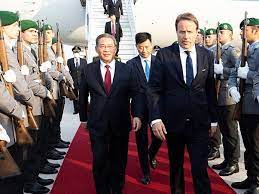

Chinese Premier Li Qiang has wrapped up his official visit to Germany and France, marking a significant step in strengthening bilateral ties and advancing China-Europe relations. This visit holds immense importance for both sides, providing an opportunity to foster cooperation, address misunderstandings, and navigate the complex dynamics of the relationship amidst changing global circumstances.
Premier Li’s visit aimed to implement the Chinese leadership’s vision of promoting China-Europe ties and consolidating the longstanding friendship between China, Germany, and France. It is crucial to emphasize that China’s intention is not to charm or exploit Europe as a vulnerable entity but to establish a strategic partnership based on mutual benefit and shared interests. China sincerely hopes to prevent a scenario where a strategic partner, with no fundamental conflicts, succumbs to external instigation and internal irrational emotions, resulting in mutual losses. China is committed to making every effort to avoid such a situation.
During his visit, Premier Li engaged in various meetings and discussions. He held talks with German President Frank-Walter Steinmeier, German business leaders, and co-chaired the seventh China-Germany inter-governmental consultation with German Chancellor Olaf Scholz. Premier Li also embarked on an official visit to France and attended the Summit for a New Global Financing Pact. These engagements allowed him to convey China’s goodwill and sincerity, clarify China’s stance on critical issues, and yield positive outcomes.
The visit has had a notable impact on public opinion in Europe, fostering a more pragmatic and rational view of China, at least in the short term. Business leaders have shown particular enthusiasm, as demonstrated by Chancellor Scholz’s rejection of decoupling and his affirmation that “de-risking” is not synonymous with “de-sinicization.” Reports indicate that the two countries signed over 10 cooperation agreements in areas such as advanced manufacturing and environmental protection, further solidifying consensus on addressing climate change and promoting green development. These developments have bolstered confidence in the prospects of China-Europe relations and pragmatic cooperation.
Undoubtedly, differences exist between China and Europe on certain issues, both longstanding and emerging. The primary challenge lies in political and ideological disparities, with anti-China forces persisting in their efforts until they reach a dead end. While strenuous efforts must be made to overcome these obstacles, it is essential to prepare for the complexity and unpredictability of current and future China-Europe relations. Anti-China forces in Europe have recently intensified their activities, generating significant noise and seeking opportunities to disrupt progress.
Many government officials in European countries fear being labeled as “soft on China,” which puts them in politically vulnerable positions. Consequently, they may choose to cater to populist sentiments rather than safeguard national interests. Such compromises create unnecessary difficulties for China-Europe relations. To achieve strategic autonomy in Europe and ensure the healthy development of China-Europe relations, true politicians and strategists must transcend this predicament.
Misunderstandings and misperceptions can largely be resolved through enhanced communication and exchanges. This principle holds true for China-Europe relations as well. Premier Li’s visit to Europe showcased the strong willingness of both sides to engage in dialogue and cooperation, forming the foundation for mutual understanding. Premier Li’s statement, “the biggest risk is non-cooperation, and the biggest hidden security danger is non-development,” resonated widely in Europe. Discerning individuals readily grasp China’s stance and attitude toward the development of China-Europe relations.
Europe’s current predicament lies not in whether to cooperate with China but rather in determining the nature and scope of that cooperation. However, when mutually beneficial cooperation gives way to politicization, ideological entanglements, and security concerns, the collaboration environment inevitably suffers fundamental damage. This leads to political confrontation, security