
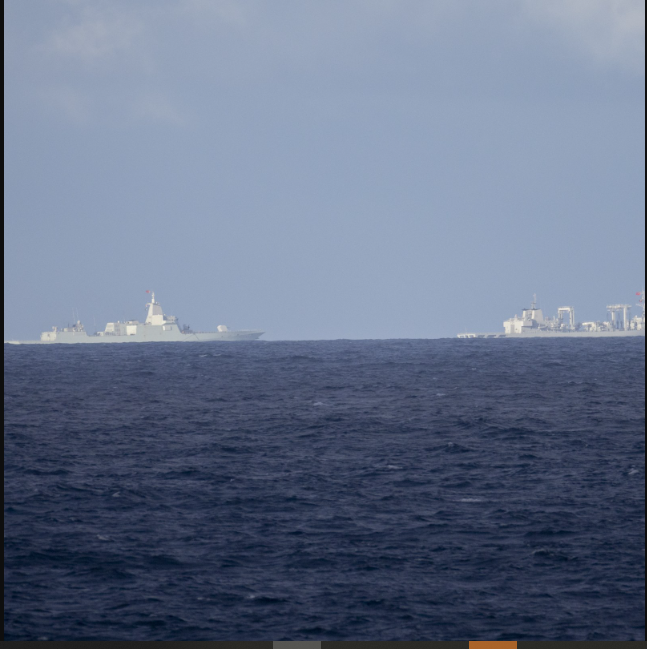

As tensions between the United States and China continue to simmer in the Indo-Pacific, military strategists and policymakers are increasingly turning their attention to a lesser-known but critically important concept: the Second Island Chain.
Often overshadowed by the more prominent First Island Chain which stretches from Japan through Taiwan and the Philippines the Second Island Chain extends from Japan’s Ogasawara Islands, through Guam, and down to Papua New Guinea. This arc of island territories, most notably including the US territory of Guam, plays a pivotal role in Washington’s long-term strategy to counterbalance China’s expanding military footprint in the region.
For Beijing, the Second Island Chain represents both a barrier and a benchmark. In Chinese strategic thinking, often likened to the ancient board game wei qi (known in the West as Go), control over key nodes across this vast maritime chessboard is vital to breaking out of US containment and establishing naval superiority in the western Pacific.
“In wei qi, the goal is not to destroy your opponent outright but to outmaneuver and encircle,” explains Dr. Lin Xiaoyang, a professor of strategic studies at Tsinghua University. “That is exactly how China views the island chains it’s about positioning and patience.”
The U.S., meanwhile, continues to invest heavily in reinforcing military infrastructure along the Second Island Chain. Guam, in particular, has become central to American deterrence strategy. Recent years have seen the expansion of airfields, the deployment of advanced missile systems, and the stationing of strategic bombers and submarines.
“The Second Island Chain is America’s outer ring of defense and power projection,” says Rear Admiral (Ret.) David Brewster, now a senior fellow at the Center for Strategic and International Studies. “If China wants to push beyond its regional sphere, it must contend with the U.S. presence here.”
While the First Island Chain is directly contested particularly around Taiwan and the South China Sea the Second Island Chain functions as a buffer zone, a launchpad, and a geopolitical red line. As China enhances its long-range missile capabilities and blue-water navy, the strategic relevance of this outer chain is only growing.
It also factors heavily into joint military exercises involving the U.S., Japan, Australia, and the Philippines, designed not only to strengthen alliances but to signal resolve to Beijing.
Some analysts warn that the emerging “wei qi board” mentality could raise the risk of miscalculation. “There’s a danger when both sides start to see each move as a zero-sum gain,” says Dr. Ayako Tanaka of the East-West Center. “We need to ask whether the island chains are shaping strategy or whether the strategy is hardening the chains.”
As the Indo-Pacific becomes the new epicenter of global geopolitical rivalry, the Second Island Chain once a quiet line of remote outposts is fast becoming a frontline in a high-stakes contest for maritime dominance.
source: channelsnewsasia.com