
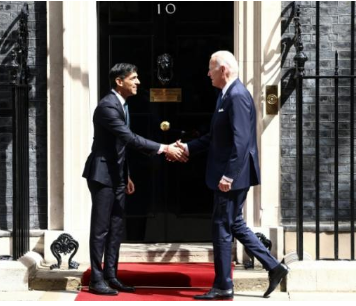

US President Joe Biden’s visit to the UK ahead of the NATO summit has raised speculation about the efforts of the US and the UK to dominate and maintain their influence within NATO. Chinese analysts believe that the two countries will work to make their strategy of “preventing the Ukraine crisis from ending” the consensus of the military organization.
President Biden arrived in London on Sunday as part of his three-nation tour, which includes meetings with UK Prime Minister Rishi Sunak and a discussion on climate change with King Charles at Windsor Castle. Analysts suggest that the diplomatic activities leading up to the NATO summit will focus on strengthening coordination on how to handle the ongoing Ukraine crisis, as NATO plays a crucial role in the US-UK cooperation to influence the development of the geopolitical crisis affecting Europe.
Experts argue that the US and the UK, being geographically distant from the conflict, are less impacted than continental European nations and therefore encourage Ukraine to continue fighting rather than seeking a ceasefire. This approach has consequences for the entire continent. Song Luzheng, a European politics expert, explains that while Eastern European countries welcome the US presence and support Ukraine’s fight, some Western European nations seek strategic autonomy and aim to reduce US interference.
By exerting influence on Eastern European nations, Washington and London can shape the consensus of the entire NATO alliance and pressure major EU members like France and Germany to align with their stance. However, maintaining unity within the alliance remains challenging. The Associated Press highlights strains on NATO’s unity, including disagreements over admitting Sweden as a member, inadequate military spending by member nations, and difficulties in selecting the next secretary-general.
Chinese military expert Song Zhongping notes that although Biden and Sunak will coordinate to strengthen their dominance within NATO, differences among the member states are expected to surface during the summit. Key areas of contention include the provision of cluster munitions to Ukraine, Kiev’s request for NATO membership, and NATO’s expansion into the Asia-Pacific region. Some EU members, like France and Germany, prioritize European security concerns and may not be interested in security matters outside their region. Washington’s desire to internationalize NATO and replicate its confrontational approach in the Asia-Pacific region may face opposition from other NATO members.
The upcoming NATO summit in Lithuania will serve as a platform to address these issues and reveal the diverging perspectives and interests within the alliance.