
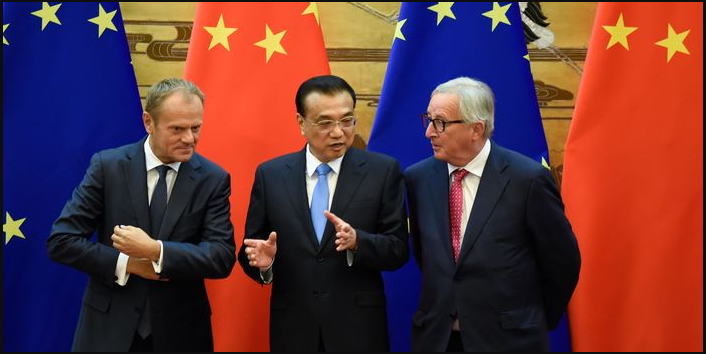

As trade tensions between the United States and China escalate into a prolonged economic rivalry, the European Union is quietly maneuvering to expand its geopolitical and economic leverage particularly in its dealings with Beijing.
Long accustomed to playing a balancing act between the world’s two largest economies, the EU now sees the deepening superpower standoff as a rare strategic opening. With Washington and Beijing entrenched in tit-for-tat tariffs, tech bans, and competitive decoupling, Brussels is positioning itself as a pragmatic middle power one capable of extracting concessions and asserting autonomy in trade, green technology, and global standards.
“Europe is no longer content to be a bystander,” said Sophie de Montluc, a senior policy advisor at the European Council on Foreign Relations. “The transatlantic rift with China gives Brussels room to press Beijing on trade imbalances, industrial subsidies, and market access without appearing to follow Washington’s hardline playbook.”
Recent moves suggest a more assertive EU stance. The European Commission has launched multiple anti-subsidy probes into Chinese electric vehicle imports, citing concerns over market distortion. Brussels has also tightened scrutiny of Chinese investments in strategic sectors, from semiconductors to renewable energy, echoing but not fully mirroring U.S. national security concerns.
At the same time, EU leaders have reiterated their “de-risking” strategy a calibrated approach that distances European supply chains from China without a full economic severance. This strategy allows Brussels to maintain critical trade ties with China while insulating itself from potential geopolitical fallout.
Beijing, for its part, has responded cautiously. Chinese officials have stepped up diplomatic outreach, offering reassurances to European partners and pushing for multilateral cooperation. Analysts say China is keen to prevent the EU from aligning too closely with the United States on punitive trade policies.
“The EU’s value to China has arguably increased,” said Dr. Tobias Lindner, a geopolitical analyst at the Berlin-based Institute for Global Affairs. “Amid growing hostility from Washington, Beijing now sees Europe as a necessary counterbalance and that gives Brussels leverage it hasn’t had before.”
However, Brussels’ tightrope walk is not without risks. European industries remain heavily intertwined with Chinese supply chains, and a sharp downturn in EU-China trade could exacerbate economic pressures at home. Moreover, any perception of siding too closely with either superpower could undermine the EU’s credibility as a neutral actor.
For now, the EU appears determined to chart its own path one that maximizes its influence in a world increasingly shaped by Sino-American rivalry.
In a time of global fragmentation, Europe may be discovering the quiet power of being in between.
source: scmp.com