
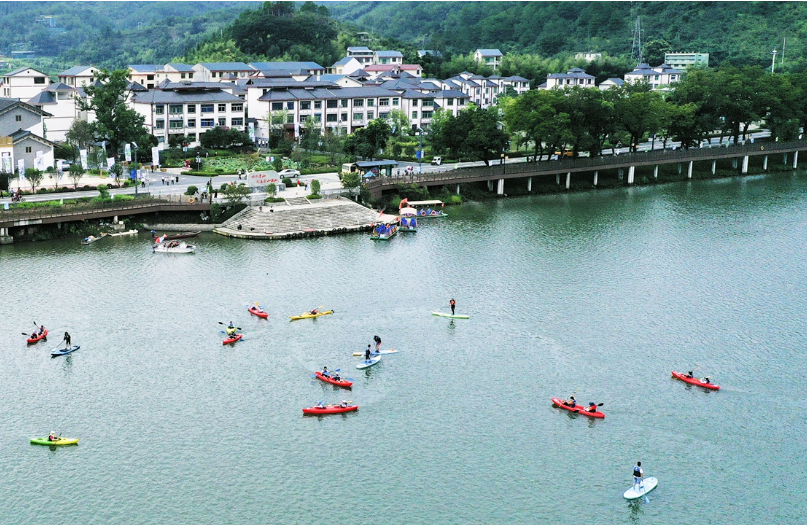

China’s inaugural National Ecology Day, observed on August 15, has marked a significant milestone in the country’s ongoing commitment to environmental conservation and sustainable development. The day serves as a testament to China’s dedication to the core concept of “lucid waters and lush mountains are invaluable assets,” inspiring widespread efforts to preserve its natural resources.
Chinese President Xi Jinping, on this occasion, called upon society as a whole to fervently advocate and exemplify the ethos that values clear waters and verdant landscapes as invaluable treasures. Xi emphasized that ecological conservation is pivotal for the sustainable progress of the Chinese nation as it embarks on a journey to build a modern socialist country across all facets of society.
While pursuing high-quality development, China is placing strategic emphasis on ecological advancement and setting its sights on carbon peaking and carbon neutrality. This entails a shift from merely controlling energy consumption to a dual-control mechanism encompassing both the amount and intensity of carbon emissions. Notably, China has set ambitious targets to peak carbon emissions by 2030 and achieve carbon neutrality by 2060.
The significance of the National Ecology Day extends beyond domestic awareness, as it offers an opportunity to share China’s achievements in ecological civilization construction with the international community. This engagement facilitates global cooperation on environmental and climate governance, ultimately contributing to a shared future for humanity.
China’s commitment to ecological conservation is evident in various initiatives and policies. The Ministry of Natural Resources recently released a bluebook outlining ecological conservation red lines spanning approximately 3.19 million square kilometers, safeguarding vital ecological functions. This comprehensive approach includes protection of water resources, biodiversity, soil and water conservation, windbreak and sand fixation, as well as addressing environmentally sensitive and fragile areas prone to erosion and desertification.
China’s dedication to biodiversity protection is underscored by its elevation to a national strategy. Over the years, the country has taken substantial steps to conserve biodiversity, including the establishment of an innovative ecological conservation red line system that covers the entire nation.
Through a network of monitoring measures utilizing satellites, aircraft, and ground patrols, China is closely monitoring ecological quality across various reserves and key areas. Notably, the country boasts a range of laws, regulations, and local provisions—over 30 laws and more than 100 administrative regulations—that lay the groundwork for a robust system of ecological civilization.
China’s efforts in ecological restoration have transformed not only its own landscape but also contribute to global green coverage. The country’s successful transition from resource-intensive practices to greener industries, as witnessed in Huzhou’s Yucun village, serves as a model for prioritizing local ecology while fostering economic growth.
Observers believe that China’s proactive approach to ecological governance not only addresses domestic environmental concerns but also positively impacts global sustainable development and climate management. Through collaborative initiatives and international cooperation, China is emerging as a key player in global environmental management, paving the way for addressing challenges like climate change on a global scale.