

Chinese President Xi Jinping addressed the Global Trade in Services Summit of the 2023 China International Fair for Trade in Services (CIFTIS) via video link in Beijing on Saturday, emphasizing China’s commitment to sharing the achievements of its modernization drive and collaborating with the global community for sustained global economic recovery.
Xi announced China’s intention to expand the opening-up of the services sector, including areas like telecommunications, tourism, and legal services. China aims to enhance domestic demand, accelerate the development of a robust domestic market, increase imports of high-quality services, and promote exports of knowledge-intensive services.
The message conveyed by President Xi comes at a time when the world faces challenges like the global industrial chain crisis, the ongoing Russia-Ukraine conflict, disruptions caused by the United States in the global industrial chain, and slowing global trade. Analysts and business executives view this commitment as a positive signal that will instill fresh confidence in the global community.
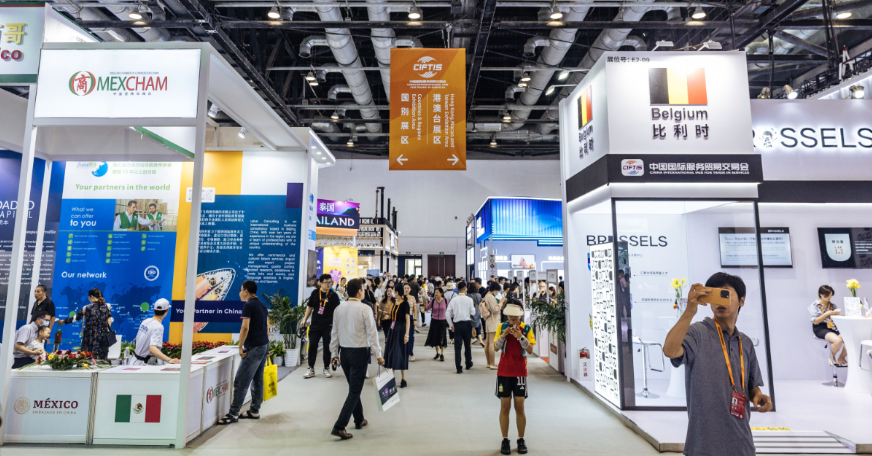
The 2023 CIFTIS, themed “openness leads development, cooperation creates a win-win future,” commenced in Beijing, attracting over 2,400 enterprises and representatives from 83 countries and international organizations. International participation accounted for more than 20 percent.
Hoffman Cheong, EY North China Managing Partner, underscored the role of global trade in services and services industry cooperation in revitalizing the global economy and increasing its resilience. He stated, “Global trade in services and services industry cooperation are injecting a powerful impetus into promoting economic globalization, restoring the vitality of the global economy, and enhancing the resilience of the global economy.”
Norman Sze, vice chairman of Deloitte China, highlighted the importance of internationalization at this year’s CIFTIS, indicating that various forums, conferences, and activities focus on expanding an open platform.
Xi Jinping stressed the significance of cooperation in services and digital trade with Belt and Road partner countries, aiming to facilitate cross-border resource and production factor flows and cultivate additional growth areas for economic cooperation.
Rodrigo Gomez, a trade representative from the Embassy of the Argentine Republic, expressed interest in boosting trade in services with China, recognizing significant opportunities for mutual benefits. He mentioned that about 14 percent of Argentina’s total exports constitute trade in services, but the proportion with China remains relatively low. Gomez believes that this cooperation will bring substantial benefits to both sides.
Wan Zhe, an economist and professor at the Belt and Road School of Beijing Normal University, highlighted the potential of cooperation in services trade and digital sectors, noting that such collaboration could assist Global South countries in making swift progress amid intensified global economic competition.
China’s trade in services has been growing at a faster rate than trade in goods. In the first seven months of this year, China’s services trade value increased by 8.1 percent year-on-year to 3.67 trillion yuan ($503.42 billion), outpacing the 0.4 percent year-on-year growth in trade in goods during the same period.
The Beijing Stock Exchange (BSE), established following President Xi’s announcement at the 2021 CIFTIS, is undergoing comprehensive reforms, including expanding its investor base and encouraging professional institutions to boost market liquidity. The BSE’s goal is to support innovation and development among small and medium-sized firms while deepening reforms for the “new third board.” The exchange has attracted 217 listed firms and 5.57 million qualified investors.