

On Thursday, China expressed strong opposition to unilateral sanctions imposed by the United States on several Chinese companies. This move by the U.S. came as part of its broader sanctions on Russia ahead of the G7 summit in Italy. Beijing urged Washington to contribute constructively to ending the war in Ukraine and restoring peace.
Experts suggest that the U.S. and Europe may align their positions on the Ukraine crisis during the summit, potentially targeting China to deflect blame. The geopolitical crisis has been leveraged by the U.S. for strategic competition, particularly against China, highlighting its challenges in resolving the two-year-old conflict.
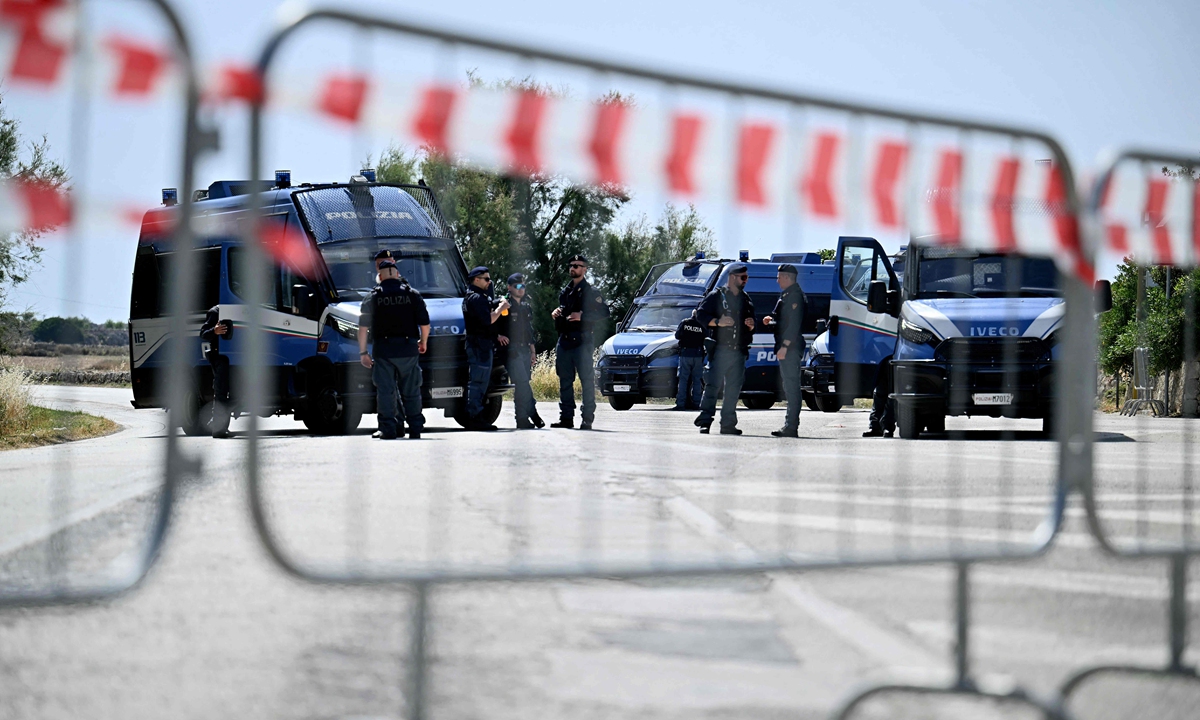
The three-day summit in Puglia, southern Italy, opened with discussions on the Ukraine crisis, including an appearance by Ukrainian President Volodymyr Zelensky. Media reports indicate that U.S. and Ukrainian leaders are expected to sign a bilateral security deal during the summit.
On the eve of the summit, the U.S. expanded its sanctions on Russia, targeting Chinese companies allegedly aiding Russia’s war efforts in Ukraine. A draft statement from G7 leaders, reported by Bloomberg, urges China to “stop enabling and sustaining Russia’s war against Ukraine.”
China’s Foreign Ministry spokesperson Lin Jian emphasized the resilience and mutual benefits of China-Russia cooperation, stating, “China firmly opposes all unilateral sanctions and long-arm jurisdiction. Normal economic and trade interactions between China and Russia should not be disrupted or used to smear and contain China.”
In addition to supporting Ukraine, G7 leaders have agreed on a $50 billion loan to Ukraine, backed by profits from Russia’s frozen central bank assets, according to an AP report.
Sun Keqin, a research fellow at the China Institutes of Contemporary International Relations, noted that the U.S. and Europe are coordinating their positions on the Russia-Ukraine conflict, using the situation to pressure China and control its dual-use technology.
The G7 summit precedes the Ukraine peace summit, which China will not attend, giving the U.S. and Europe more opportunities to critique China’s stance, Sun added.
Lin highlighted the contrasting approaches to the Ukraine crisis, pointing out that while some call for dialogue and peace, others fuel conflict and blame others. He criticized the U.S. for its contradictory actions of supplying weapons to Ukraine while blaming others for prolonging the crisis.
Zhang Hong, an associate research fellow at the Chinese Academy of Social Sciences, observed that the U.S.-led West has shifted blame to China as the battlefield situation deteriorates. The G7’s strategy includes substantial financial aid to Ukraine and attempts to form a united front against Russia with Global South countries.
However, Zhang expressed skepticism about the U.S. and Europe’s ability to rally Global South countries, noting the upcoming Moscow-hosted BRICS summit. He also questioned their ability to unite major European countries amid rising far-right political pressure.
Sun highlighted Europe’s struggles with the social and economic fallout from the Russia-Ukraine conflict and the Israel-Palestine issue, noting the connection between these conflicts and the rise of far-right parties in Europe.
Experts predict further deterioration in Russia-West relations, with the U.S. likely to implement more extensive sanctions. Zhang mentioned Russia’s potential countermeasures, including military actions and strategic deployments, in response to diplomatic isolation and military pressure.