


China took decisive action on Tuesday by reducing the loan prime rate (LPR), in line with market expectations, after a nine-month period without change. This move, the third rate cut within a week, signifies China’s determination to stimulate its ongoing economic recovery and tap into its growth potential amidst a complex global geopolitical landscape and weakening global demand.
Despite some recent economic indicators suggesting a moderate growth pace, experts emphasized that the world’s second-largest economy remains firmly on track for sustained recovery. The Chinese government swiftly responded to challenges facing the economy and is implementing stimulus measures to bolster market expectations and confidence.
According to the National Interbank Funding Center, the one-year loan prime rate (LPR) dropped to 3.55 percent from the previous rate of 3.65 percent on Tuesday. Additionally, the LPR for over-five-year loans, which influences mortgage rates for many lenders, was reduced by 10 basis points to 4.2 percent.
The interest rate cuts on Tuesday were widely anticipated, considering the recent frequency of interest rate reductions by the People’s Bank of China (PBC), the country’s central bank. Typically, adjustments in policy rates occur in tandem.
Last Thursday, the PBC decreased the interest rate on its one-year medium-term lending facility (MLF) loans to financial institutions from 2.75 percent to 2.65 percent. This move injected 237 billion yuan ($33.1 billion) into the market using a liquidity instrument.
Furthermore, on the previous Tuesday, the central bank lowered the seven-day reverse repo rate from 2 percent to 1.9 percent, injecting funds into the financial system. Simultaneously, the PBC also reduced rates on its short-term standing lending facility by 10 basis points.
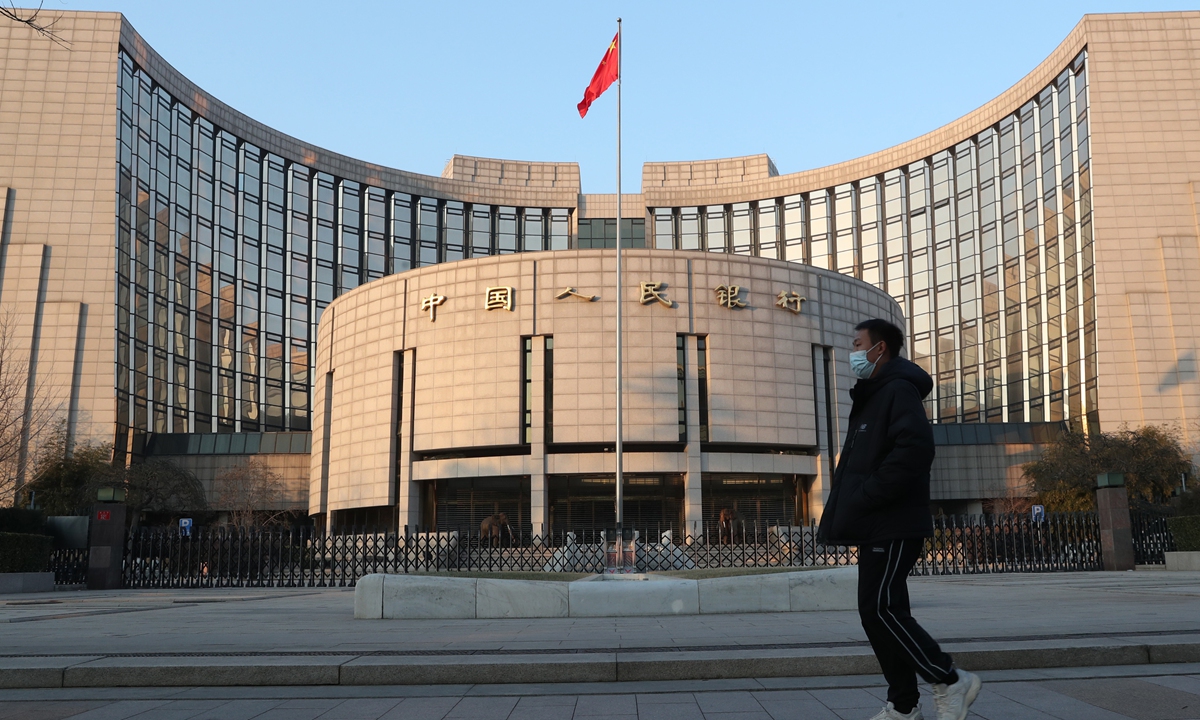
“The adjustment on Tuesday carries a direction-pointing significance,” Yan Yuejin, research director at the Shanghai-based E-house China R&D Institute, said in a note sent to the Global Times on Tuesday.
“It has positively responded to the spirit of the recent State Council executive meeting. It is the first card in a package of stimulus plans, meaning that decisive moves to lift economic activity have fully begun,” Yan noted.
China is mulling policies to promote a sustained recovery of its economy, according to the State Council executive meeting chaired by Premier Li Qiang on Friday. The meeting adopted an action plan to support financing for technology-based enterprises and a draft regulation on the supervision and administration of private investment funds.
“The rates cut has substantial significance for the reduction of medium- and long-term loan costs, which means that subsequent efforts will continue to be made in reducing costs across the real economy, conducive to enhancing market expectations and confidence,” Yan said.
Full-swing recovery underway
China’s recent slew of moves to trim policy rates come amid a stable yet relatively moderate recovery pace of the economy, as the real estate market continues to exert a drag on investment since the start of the second quarter.
China’s three major economic indexes saw moderate growth in May, slightly missing market expectations, with industrial output rising 3.5 percent and retail sales expanding 12.7 percent on a yearly basis, data from the National Bureau of Statistics (NBS) showed.
Fixed-assets investment also slowed mainly due to the real estate sector, where investment in the first five months of the year declined 7.2 percent on a yearly basis, extending the 6.2 percent fall registered in the January-April period.
“We can’t deny that China’s economy is firmly making headway in its recovery trajectory, despite factors exerting a drag on the process, which is natural,” Lian Ping, chief economist and head of the Zhixin Investment Research Institute, told the Global Times on Tuesday, defying Western media hype that seeks to disparage the potential and momentum of the still unfolding economic recovery.
Efforts to unleash domestic demand and stabilize market expectations and confidence are crucial for the economic rebound at present, and stimulus packages should aim in this direction, according to Lian.
This echoes the opinion of Li Daokui, director of Tsinghua University’s Academic Center for Chinese Economic Practice and Thinking, who believes there is still huge potential for domestic economic growth.
“There are two key ways to boost confidence. One is to introduce policies to boost consumer confidence as soon as possible, while the other is to stimulate investment by private enterprises by offering reassurance to them,” Li said at a forum on Saturday.
Consumption, for example, will play more of a driving force for economic growth by expanding domestic demand, with more stimulus measures to be rolled out by local governments in the summer, a traditional consumption peak, Lian noted.
“For the full year, consumption will be a highlight among the economic indicators,” he added.In the first five months of the year, total consumer retail spending hit 18.76 trillion yuan ($2.6 trillion), up 9.3 percent from a year ago, accelerating 0.8 percentage points compared with that of the January-April period and 3.5 percentage points compared with that of the first quarter, NBS data revealed.

The upcoming Dragon Boat Festival holidays from Thursday to Saturday are also expected to inject momentum into domestic spending following the stellar May Day holiday performance when trips and revenues both surpassed pre-COVID levels.
“With the implementation of policy interest rate cuts and other stimulus measures in the pipeline in the remainder of the year, the process of widening access to credit will speed up, which will accumulate strength for the economic recovery in the third quarter,” Wang Qing, chief macroeconomic analyst at Golden Credit Rating International, told the Global Times on Tuesday.
“Multiple localities are likely to further increase the issuance of consumption vouchers and consumption subsidies to enhance residents’ consumption capacity, and the focal points would be on new-energy vehicles, smart home appliances, green building materials and other bulk consumption areas,” Wang said.
In terms of macro adjustment, there is still the possibility of further interest rate cuts and reserve requirement ratio (RRR) cuts in the remainder of this year, according to an analysis note sent by CITIC Securities.
Foreign-invested capital is also rooting for the recovery prospect of the Chinese market, as reflected by a stream of visits by multinational executives to the country in search of cooperation since the start of the year, including most recently, Bill Gates, co-founder of Microsoft and co-chair of the Bill & Melinda Gates Foundation, and Tesla CEO Elon Musk.
From January to May this year, a total of 18,532 foreign-invested enterprises were newly established across the nation, up 38.3 percent year-on-year, data from the Ministry of Commerce showed.