
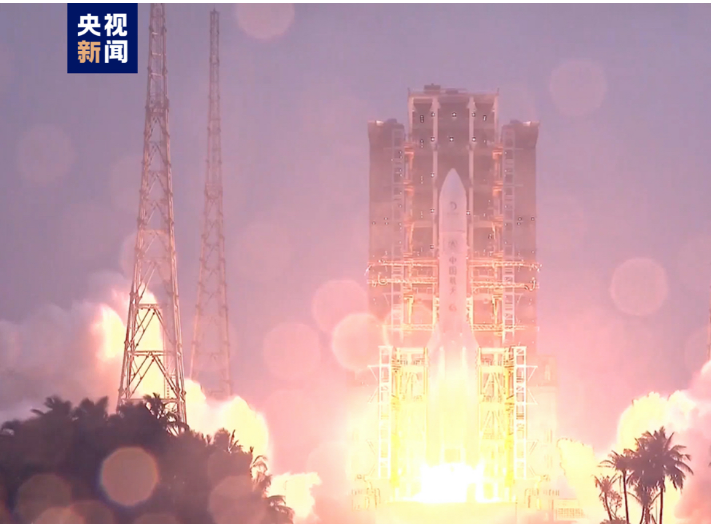

China achieved another milestone in its space exploration efforts on Friday with the successful launch of the Long March-5 Y8 carrier rocket, which lifted off at 5:27 pm from the Wenchang Space Launch Site in Hainan, South China. The launch marked the commencement of the Chang’e-6 mission, aiming to retrieve lunar samples from the far side of the Moon, a feat never before attempted in the world.
The China National Space Administration (CNSA) confirmed the launch’s success, reporting that the spacecraft’s solar panels deployed smoothly following liftoff.
Chang’e-6’s round trip to the Moon and back is anticipated to span approximately 53 days, more than double the duration of its predecessor, Chang’e-5. This extended duration underscores the mission’s complexity, featuring 11 distinct stages designed by researchers, including launch, orbit insertion, and lunar transfer.
The mission aims to collect a larger quantity of lunar samples compared to Chang’e-5, targeting around 2,000 grams of lunar dust and rocks. Furthermore, Chang’e-6 seeks to pioneer advancements in lunar retrograde orbit design, intelligent sampling on the far side of the Moon, and lunar surface ascent, as outlined by the CNSA.
Upon reaching lunar orbit, the probe will execute intricate maneuvers, culminating in a landing on the Moon’s far side. Following sample collection, the ascent module will rendezvous with the orbiter-returner combination to transfer the lunar samples for the journey back to Earth. The return capsule is slated to land in Siziwang Banner, Inner Mongolia Autonomous Region, employing a semi-ballistic skip re-entry approach.
Chang’e-6 will employ drilling and scooping techniques akin to Chang’e-5 to gather samples from diverse layers and depths of the lunar surface, concurrently conducting scientific exploration.
The mission’s target area for drilling is the Aitken Basin in the lunar south pole, renowned for its geological significance and potential reservoirs of water ice, offering valuable insights into lunar origin, planetary evolution, and the solar system’s formation.
In addition to its scientific objectives, the Chang’e-6 mission embraces international collaboration, carrying payloads from the European Space Agency, France, Italy, and Pakistan.
The mission aligns with China’s Phase-4 lunar exploration program, which aims to land taikonauts on the Moon by 2030. Moreover, China spearheads the International Lunar Research Station project in collaboration with Russia, with ambitious plans for lunar infrastructure development and global partnerships.
As global interest in lunar exploration intensifies, driven by resource accessibility and deep space exploration prospects, China’s Chang’e-6 mission heralds a significant step forward in humanity’s quest to unravel the mysteries of the Moon.