
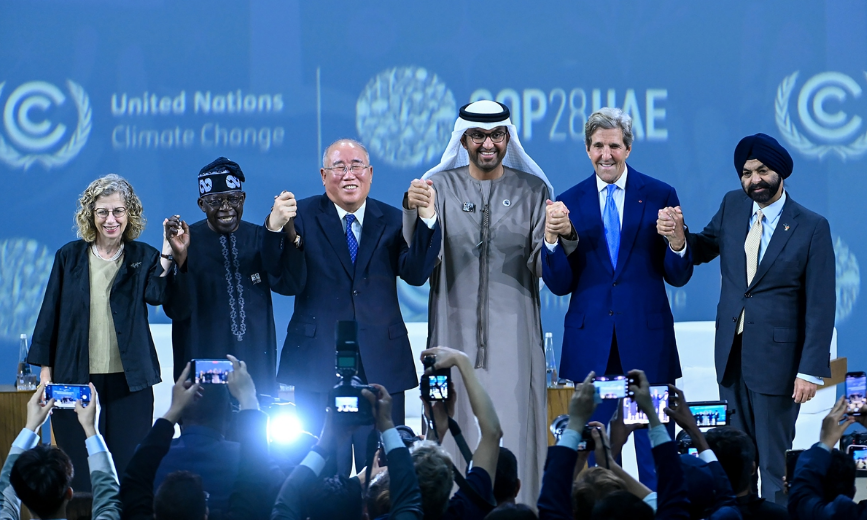

China’s climate envoy, Xie Zhenhua, stressed the pressing need for international collaboration to enhance methane control in developing nations during the 28th Conference of the Parties to the UN Framework Convention on Climate Change (COP28). Alongside US Special Presidential Envoy for Climate John Kerry, Xie called for unified global action during the event held in Dubai on Saturday.
The agreement between China and the US on reducing methane emissions was hailed by Chinese experts as a significant highlight of COP28. Analysts believe this accord will provide valuable time for the international community to address greenhouse gas emissions.
Xie, China’s special envoy for climate change, detailed the country’s efforts in methane emission control, citing policies and programs implemented in recent years. These initiatives include measures in the energy sector to reduce methane emissions from energy production and encourage recovery and reuse. In the agricultural sector, steps have been taken to promote the recycling of livestock and poultry waste and implement zero growth actions for fertilizers.
Despite these efforts, Xie acknowledged the challenges faced by developing countries, including China, in controlling methane and other non-CO2 greenhouse gases. He highlighted the late start and weak foundation of China’s methane control efforts, emphasizing the need for long-term, strenuous efforts and capacity building.
In November, China released an action plan for methane emissions control, with Xie affirming the country’s commitment to transforming institutional designs and task requirements into substantive capabilities. The plan aims to balance methane control with considerations for energy security, food security, and the well-being of the people.
John Kerry emphasized the importance of international cooperation, stating that no single country or business can address the methane issue alone. Kerry reiterated the global methane pledge to reduce emissions by at least 30 percent by 2030, aligning with the goal of avoiding over 0.2 degrees Celsius of warming by 2050.
The China-US Sunnylands Statement on Enhancing Cooperation to Address the Climate Crisis, issued last month, reaffirmed the commitment of both countries to collaborate on various climate-related issues, including methane reduction. Xie and Kerry are expected to outline detailed plans for broader cooperation during COP28.
Ma Jun, director of the Institute of Public and Environmental Affairs, praised the China-US agreement on methane emissions as a substantial achievement of COP28, offering valuable time to mitigate greenhouse gas emissions. He noted that tackling methane, despite its shorter atmospheric lifetime, is crucial due to its higher potency in trapping heat compared to carbon dioxide.
Addressing concerns raised by some foreign media about China’s action plan lacking clear targets, experts emphasized that it is an initial step. Bao Cunkuan, a professor at Fudan University, stressed the need for progress in methane emissions statistical accounting, monitoring, and supervision. Ma suggested that China can draw from the US experience in curbing methane emissions as the two nations collaborate on this crucial climate issue.