

Beijing, China — China’s economy continued its recovery trend in November, driven by a mix of government measures aimed at stimulating growth, according to data released by the National Bureau of Statistics (NBS) on Monday. Economists are optimistic about a steady rebound heading into 2025, with expectations that recent macroeconomic adjustments will provide strong support to sustain growth momentum.
Industrial Growth and Retail Sales Data
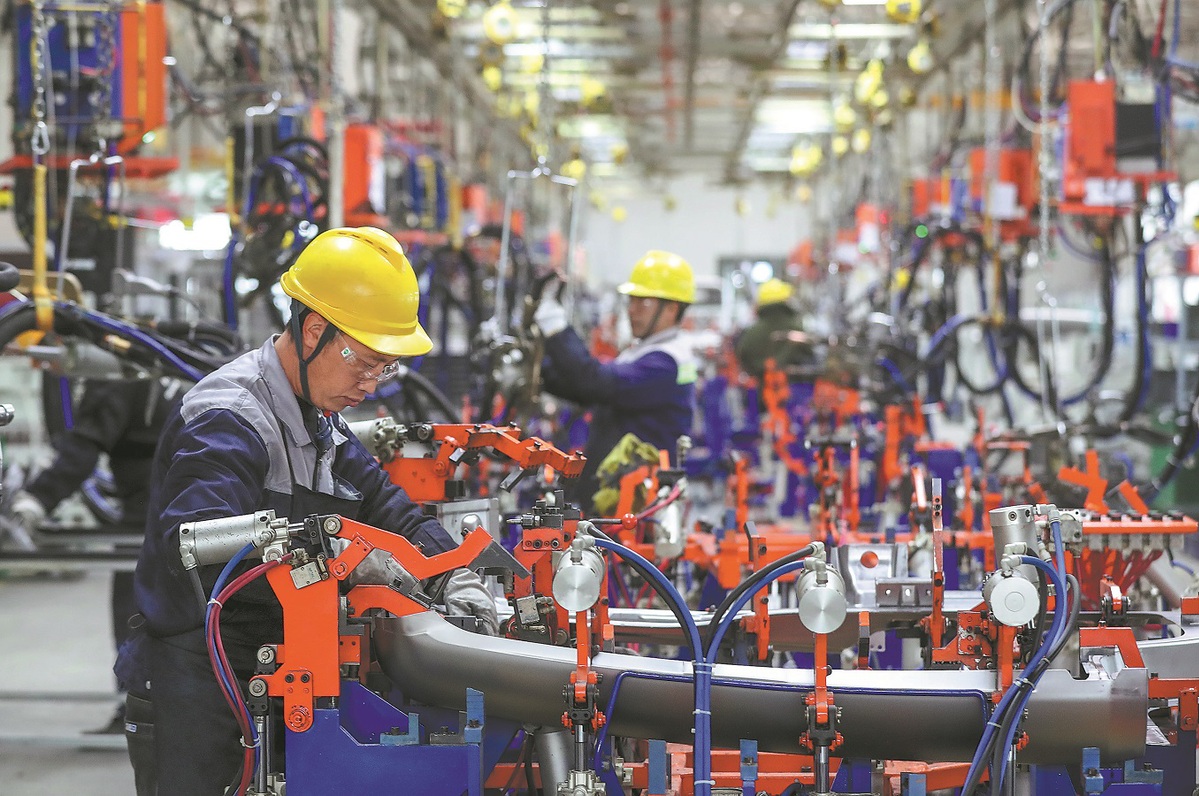
The data showed that value-added industrial output grew by 5.4% year-on-year in November, slightly up from a 5.3% increase in October. This growth was largely driven by a boost in manufacturing production, indicating the effectiveness of recent fiscal and monetary policies aimed at revitalizing the industrial sector.
Wang Qing, Chief Macroeconomic Analyst at Golden Credit Rating International, noted, “This improvement reflects the impact of incremental policy measures that have bolstered market confidence and supported demand recovery, with strong export performance providing a significant boost to industrial activity.” He added that industrial production growth could remain robust, with December’s growth expected to range between 5% and 6%.
However, the data showed that retail sales growth slowed to just 3% year-on-year in November, down from 4.8% in October. Fixed-asset investment also grew at a slower pace of 3.3% year-on-year during the January-November period, compared to 3.4% in the first 10 months of the year.
Focus on Expanding Domestic Demand
Despite industrial production improvements, domestic demand remains weaker than anticipated, according to Lu Ting, Chief China Economist at Nomura. Lu pointed out that domestic consumption and investment had underperformed, and predicted that the central government would ramp up fiscal deficit spending in 2025.
The Central Economic Work Conference, a key annual meeting of policymakers, identified expanding domestic demand as a priority for the coming year. Lu forecast that China would increase its fiscal deficit in 2025 to 4% of GDP, up from 3% this year, with a total of 3.6 trillion yuan ($494.3 billion) in incremental borrowing.
Fiscal and Monetary Policy Shifts for 2025
Economists are also expecting a more proactive fiscal policy and a moderately loose monetary policy in 2025. Betty Wang, lead economist at Oxford Economics, projected fiscal stimulus of approximately 2% of GDP to be announced in March 2025. On the monetary front, she expects 40 basis points in rate cuts during the year, though she cautioned that more cuts could be possible if needed.
At the annual economic conference, Han Wenxiu, Executive Deputy Director of the Office of the Central Committee for Financial and Economic Affairs, confirmed that China would transition to a more proactive fiscal policy and a moderately loose monetary stance. This shift marks the end of a 14-year period of “prudent” monetary policy, which was implemented after the 2007-09 global financial crisis.
Expanding Domestic Consumption and Investment
The government has also indicated plans to expand domestic consumption by boosting incomes for low- and middle-income groups. Wei Jianguo, former Vice-Minister of Commerce, emphasized that the government should focus on increasing incomes, while guiding citizens toward high-quality, healthy consumption choices. Wei specifically mentioned sectors such as elderly care, healthcare, and culture and tourism as areas of potential growth for domestic consumption.
Conclusion
China’s economic recovery continues to show resilience, with key growth drivers in industrial production and exports. However, challenges remain, particularly in domestic consumption and investment. With the government’s proactive stance on fiscal and monetary policy for 2025, there is optimism that the economy will build on its recovery and foster long-term stability.