
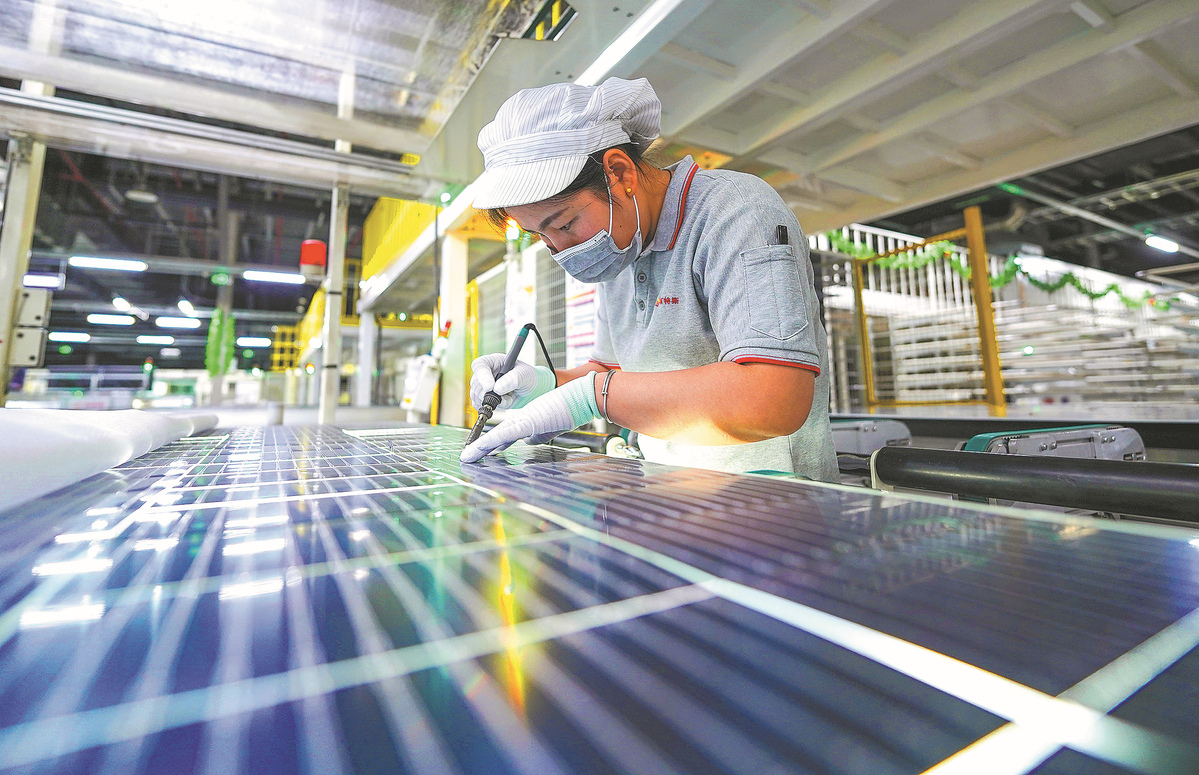

Beijing, China — China’s new energy industry is poised for substantial growth, with rising global demand and favorable conditions for international participation, according to a report released by the Development Research Center (DRC) of the State Council on Monday.
The China Development Report 2024 highlights that the new energy sector, which includes electric vehicles (EVs), solar and wind power, energy storage, and hydrogen energy, is rapidly expanding. As countries move away from traditional fossil fuels to more sustainable energy sources, China’s efforts in this area have created a favorable environment for foreign investments.
Major international players, including Tesla from the United States, BMW and Mercedes-Benz from Germany, and Toyota from Japan, have already established EV production facilities in China. This aligns with global trends, as the International Energy Agency (IEA) forecasts that global demand for electric vehicles will rise to 45 million units by 2030, more than four times the number in 2022.
China’s Growing Capacity for New Energy Production
Xu Wei, head of the DRC’s macroeconomic research department, emphasized that the rapid expansion of China’s new energy sector is designed to meet future demand. While there may be concerns about overcapacity based on current levels of demand, Xu pointed out that this growth phase is a strategic response to anticipated needs. He also highlighted the inevitability of industry competition and trade frictions in the global market, noting that restricting exports based on “overcapacity” arguments could slow the global green transformation.
The report also stresses that China’s new energy exports are already significant, with Tesla alone accounting for 28.6% of China’s EV exports in 2023. The country not only exports electric vehicles but also a variety of EV components, such as lighting, braking systems, and shock absorbers, many of which are produced by foreign companies operating in China.
A Strong Supply Chain and Technological Leadership
According to Chen Jianwei, a researcher at the University of International Business and Economics, China’s well-established supply chain and infrastructure for the new energy sector make it an attractive destination for foreign companies. This has facilitated easier integration into the local ecosystem and made it easier for international firms to scale up their operations in the country.
Sun Fuquan, a researcher at the Chinese Academy of Science and Technology for Development, echoed this view, noting that over half of the world’s green and low-carbon technologies remain underdeveloped. This creates a gap between the growing demand for low-carbon development and the limited availability of affordable green technologies. China, however, has found effective technological pathways for decarbonization in sectors like energy and transportation, and by applying these technologies on a large scale, the country has significantly reduced the cost of new energy products.
Strong Export Growth
China’s new energy vehicle exports continued their upward trajectory, with 1.14 million units exported during the January-November period of 2024, marking a 4.5% year-on-year increase, according to the China Association of Automobile Manufacturers.
In summary, China’s new energy sector is well-positioned to capitalize on the growing global demand for sustainable energy solutions, with a strong domestic supply chain, technological innovation, and increasing foreign investment. The country’s proactive approach in expanding this sector is set to play a key role in the global green energy transition.