
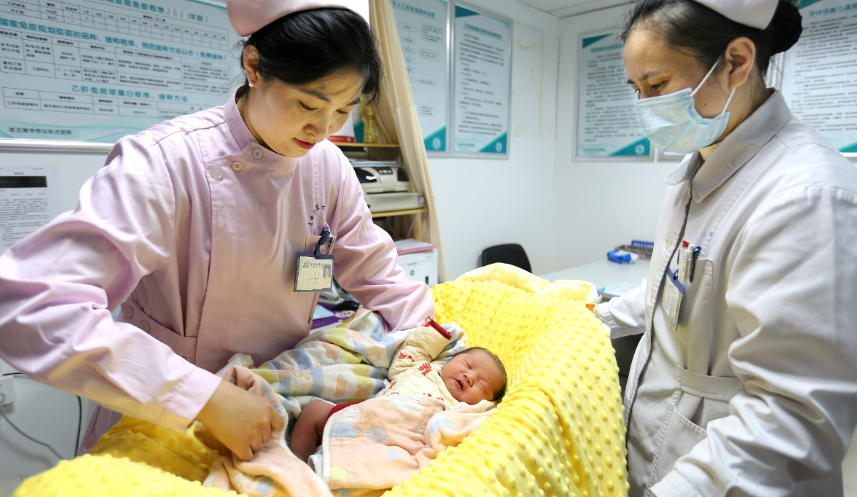

Chinese medical professionals and experts are forecasting a potential minor baby boom in the Year of the Dragon, attributing it to a triple impact: the cultural preference for the dragon zodiac, a rebound in fertility post-pandemic, and improved fertility support policies.
On the first day of the Year of the Dragon, nine dragon babies were delivered at Fudan University Affiliated Maternity Hospital by 8 am, while Shanghai First Maternity and Infant Health Hospital received seven dragon babies between midnight and 8 am, reported local news portal thepaper.cn.
In the early hours of Saturday, the Fengxian branch of the International Peace Maternity and Child Health Hospital in Shanghai celebrated the birth of the first dragon baby of the year at 1:47 am, weighing 3,057g. By 8 am, four dragon babies, including three boys and a girl, were born in the Fengxian District.
Anticipating the Year of the Wood Dragon, hospitals across China reported the birth of dragon babies, and medical staff expect a slight baby boom. According to Chinese culture, the dragon symbolizes power, nobility, and intelligence, while Wood represents growth and prosperity, creating an auspicious setting for new arrivals.
Amid China’s economic recovery, the Year of the Dragon fosters hope and optimism among the Chinese population for the coming year. Prospective parents have shown an increased interest in having dragon babies, reminiscent of the previous Year of the Dragon in 2012.
Zhai Zhenwu, president of the China Population Association, previously noted that Chinese people hold a special preference for the zodiac sign “dragon,” and during the last Year of the Dragon in 2012, there was a notable baby boom. Taking into account this cultural preference and other factors, it is anticipated that the birth rate in 2024 will witness a significant rise.
The expected baby boom results from three main factors: the cultural preference for the dragon zodiac, the rebound in fertility post-pandemic, and improved fertility support policies in China. With the impacts of the COVID-19 pandemic leading to delayed childbirths, experts believe the number of newborns will increase in 2024, though the exact extent remains uncertain.