
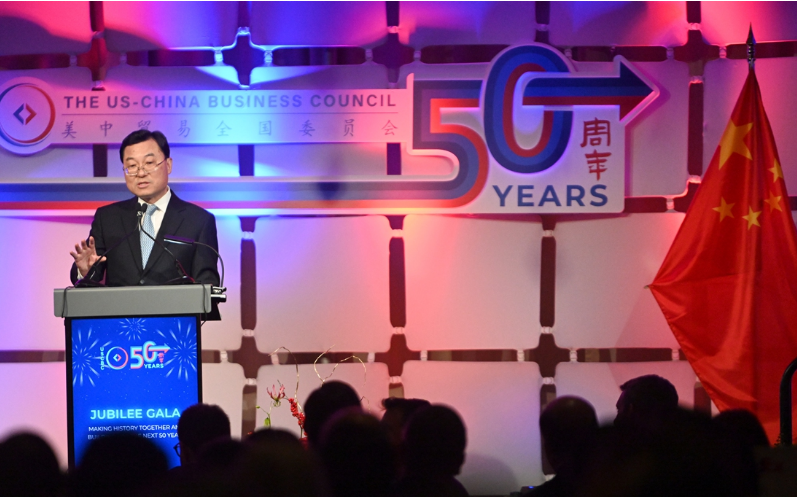

Chinese President Xi Jinping and US President Joe Biden have both conveyed their congratulations on the occasion of the 50th anniversary of the US-China Business Council (USCBC). This gesture is seen by observers as a renewed commitment emphasizing the mutual importance both nations attribute to their bilateral trade ties. The significance of these messages is particularly noteworthy following the historic meeting between the two leaders in the US last month.
In his message, President Xi emphasized that the world is undergoing a major transformation, and the ability of China and the US to collaborate in addressing challenges is crucial for the interests of both peoples and the future of humanity, according to a report from Xinhua News Agency. China stands ready, following principles of mutual respect and win-win cooperation, to work with the US in implementing the outcomes of the recent meeting and ensuring the healthy, stable, and sustainable development of bilateral relations.
The messages from the leaders underscore a commitment to sustaining cooperation between the world’s two largest economies. The timing of these remarks on the 50th anniversary of the USCBC further highlights the paramount importance of trade in bilateral ties, as noted by Li Yong, a senior research fellow at the China Association of International Trade.
Chinese Ambassador to the US Xie Feng and US Treasury Secretary Janet Yellen also addressed the USCBC event, emphasizing the role of business cooperation as an anchor in bilateral ties. Ambassador Xie urged both sides to move towards each other with sincerity and effectively utilize established mechanisms to enhance communication.
Yellen, in her speech, expressed Washington’s desire not to decouple from China and announced a planned second visit to China. She outlined steps to accelerate cooperation on climate risks and financial markets. Experts view this planned visit as further evidence that trade cooperation is in the mutual interests of both countries.
However, Chinese experts are urging more actions from the US to foster improved relations, calling for a reduction in political interference in China-US economic cooperation. They emphasize the need to carry forward the “San Francisco vision” to inject more stability into the world.
China hopes that the US will honor its commitments instead of imposing sanctions on Chinese companies, as voiced by Mao Ning, a spokesperson of the Chinese Foreign Ministry. Despite increasing exchanges between the two nations after the leaders’ meeting, some US actions, such as the recent House Select Committee report proposing aggressive measures against China’s economic ties, pose challenges to furthering bilateral relations.
Analysts emphasize the importance of the US building an accurate and objective perception of China to address persistent problems in relations, warning that geopolitical power plays and ideological suppression could lead the US policy on China to a dead end.