
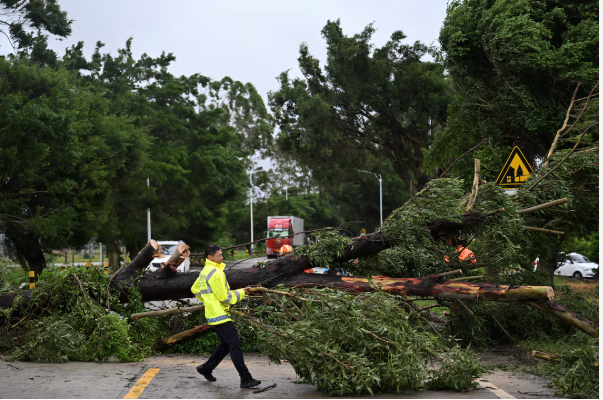

Powerful storms swept across southern China on Monday, bringing torrential rain, landslides, and widespread flooding in the aftermath of Typhoon Wipha, which made landfall over the weekend before weakening into a tropical depression. The remnants of the storm system continue to wreak havoc across Guangdong, Guangxi, and Fujian provinces, with emergency responders racing to contain the damage.
Local authorities reported at least 9 fatalities and over 50 injuries linked to storm-related incidents, including collapsed homes, traffic accidents, and flash floods. Tens of thousands have been evacuated from low-lying areas, with shelters set up in schools and community centers across multiple cities.
Transport Disruptions and Infrastructure Damage
Rail and air travel across the region remain severely disrupted. High-speed rail services between Guangzhou and Shenzhen were suspended temporarily due to waterlogged tracks and debris, while over 300 flights were cancelled or delayed at major airports including Guangzhou Baiyun and Xiamen Gaoqi.
Authorities in Zhaoqing and Meizhou reported major power outages and communication blackouts as fierce winds and rainfall toppled power lines and inundated substations. In mountainous regions of northern Guangxi, rescue workers battled mudslides and blocked roads to reach isolated villages.
The Ministry of Emergency Management raised the national emergency alert to Level II, the second-highest, and dispatched additional rescue teams to the hardest-hit counties.
Aftermath of Typhoon Wipha
Typhoon Wipha made landfall late Saturday night near the coastal city of Yangjiang in western Guangdong, packing winds of up to 130 km/h (81 mph). Though it quickly lost strength over land, its sprawling rain bands continued to drench large parts of southern China.
Meteorologists at the China Meteorological Administration warned that saturated ground conditions from previous storms had increased the risk of landslides and flash floods.
“This is a compounding disaster,” said Zhao Wen, a senior forecaster with the administration. “Even though Wipha has weakened, the moisture it brought is now interacting with seasonal monsoonal patterns, causing prolonged, intense downpours.”
Climate Change Concerns and Urban Resilience
The recent onslaught of extreme weather Wipha marks the fourth typhoon to impact China this summer is renewing concerns about climate resilience in China’s rapidly urbanizing southern corridor.
“Cities like Guangzhou and Shenzhen are vulnerable to compounded climate shocks,” said Xu Lei, an urban climate researcher at Tsinghua University. “Drainage systems are struggling to keep up with the scale and speed of these storm surges.”
Local governments have pledged to accelerate investment in flood management infrastructure and early warning systems.
Looking Ahead
Weather forecasts suggest the heavy rains will persist through midweek, with some areas in Guangdong and Guangxi expected to receive up to 250 mm of rainfall in 24 hours well above the July average. The public is advised to avoid unnecessary travel and follow evacuation directives.
Authorities have urged vigilance as more tropical systems are developing in the western Pacific.
“We are still in the peak typhoon season,” said the Ministry of Natural Resources in a public advisory. “Preparedness remains critical.